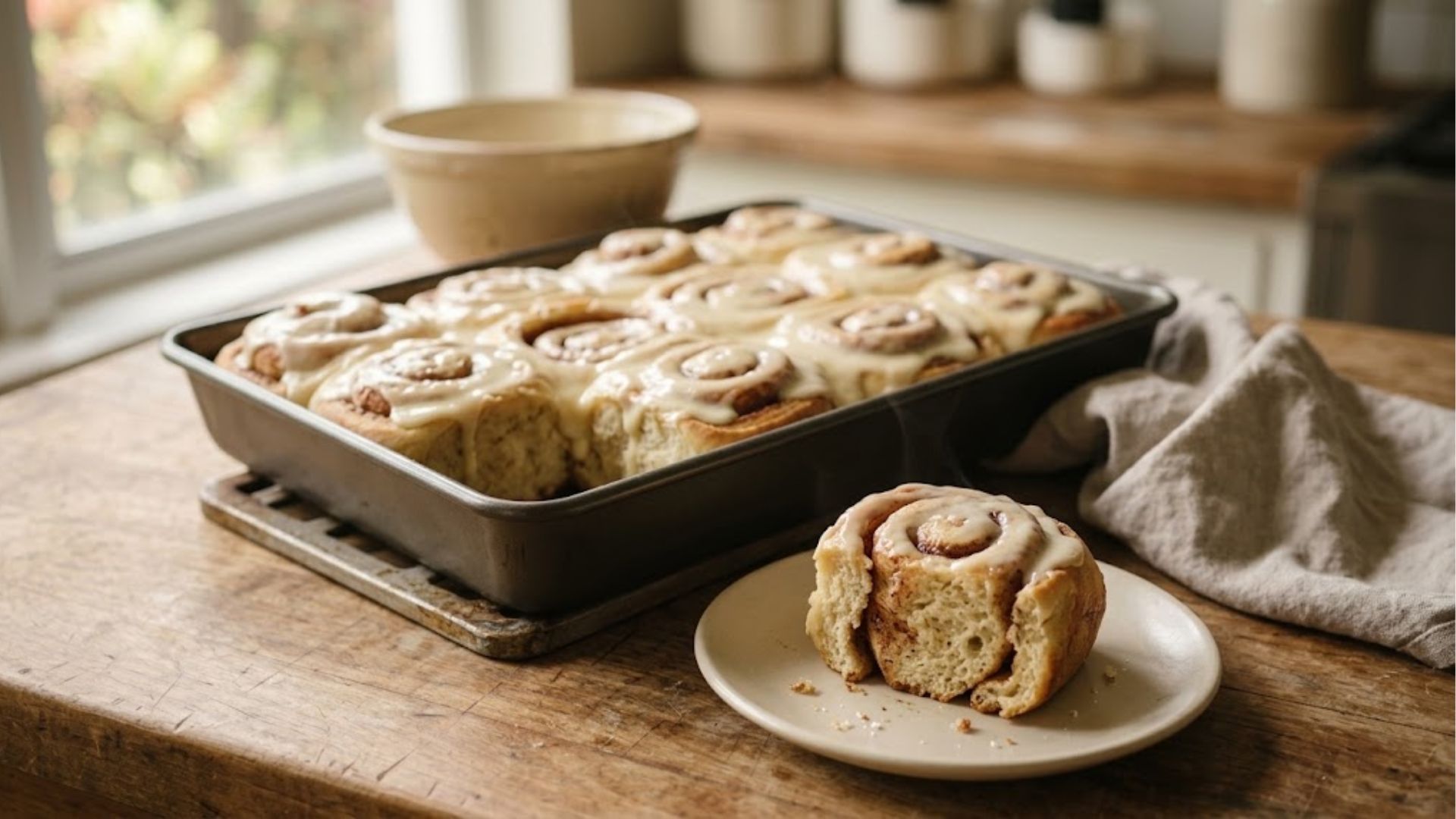
Ingredients
Equipment
Method
- Feed your gluten-free starter the night before (or morning of) so it's bubbly and active at mix time. A mature GF starter runs slower than a wheat one, so build in extra time if yours is young.
- In a stand mixer bowl, whisk together 215 g lukewarm milk, 115 g active GF starter, 50 g sugar, and 2 eggs. Melt 57 g (4 Tbsp) of the butter and whisk that in too, along with 40 g oil.
- Add 450 g King Arthur Gluten-Free Bread Flour, 9 g instant yeast, and 9 g salt. Beat on low to combine, then on medium-high for a full 3 minutes. Don't shorten this step. It's doing the structural job gluten would do in the wheat version.
- Scrape the bowl. The dough should look like a thick, smooth cake batter, not a kneadable wheat dough. If it's closer to a thin paste, beat in another tablespoon of flour; if it's stiff and dry, beat in another tablespoon of milk.
- Cover and let rise at room temperature (or in an oven with just the light on) for 1 to 1.5 hours, until visibly puffy. This is the one reliable bulk rise. It won't double the way the wheat dough does, and that's expected.
- Mix the remaining 28 g (2 Tbsp) butter with 150 g brown sugar and 2 Tbsp cinnamon for the filling. This part doesn't change for gluten-free baking, since the filling never had flour in it to begin with. Stir it to a spreadable, damp-sand texture, the same as the original.
- Line a sheet pan or your counter with parchment. Turn the dough out and, with wet hands, press it (don't roll it) into a rectangle roughly 16x12 inches and about ½ inch thick.
- Spread the filling evenly, leaving a bare 1-inch strip along one long edge. That clean strip is what the dough grabs onto when you roll it into a log, so the seam seals shut instead of popping open in the oven, which matters more here since gluten-free dough has less natural elasticity to hold a loose seam closed.
- Using the parchment to help lift, roll the dough into a tight log starting from the filled edge. Freeze the log, uncovered, for 20 to 30 minutes to firm it up. This matters more here than in the wheat version. GF dough is too soft to slice cleanly right after rolling.
- Slice into 12 rolls with unflavored dental floss or a sharp serrated knife, and arrange cut-side up in a greased 9x13-inch pan. A knife tends to compress this softer dough as it cuts, flattening the spiral, so floss gives the cleaner slice here. Slide it under the log and cross the ends over the top to pull through.
- Cover and let rise at room temperature for 1.5 to 2 hours, until puffy and the rolls are touching their neighbors.
- Near the end of the rise, preheat the oven to 350°F. Bake 24 to 30 minutes, until golden on top. Check doneness with an instant-read thermometer in the center of a roll. Look for 205 to 210°F, since GF enriched dough can look done on top before the center fully sets.
- Cool 10 to 15 minutes, then beat the softened cream cheese with powdered sugar and a splash of milk into a glaze, and spread it over the rolls while they're still warm. Warm rolls let the glaze soak in slightly for a glossy coat. Rolls that are still piping hot will just melt it into a thin puddle instead.
Notes
This dough is wetter and stickier than the wheat version. It is beaten in a stand mixer, not kneaded by hand, and pressed rather than rolled. Expect a slightly denser, more tender crumb than the original, closer to a soft spoon bread than a classic pull-apart roll.