Ingredients
Equipment
Method
- In a large bowl, mix the bread flour, whole wheat flour, and water together by hand just until no dry flour remains. Cover and rest (autolyse) for 30 minutes.
- Add the starter and salt. Mix and knead until smooth and elastic, 8-10 minutes by hand or 6-7 minutes with a stand mixer.
- Cover and bulk ferment at room temperature for 4 hours, with 3 sets of stretch-and-folds in the first 2 hours, until puffy and about 50% risen.
- Turn the dough out and shape into a tight round. Place seam-side up in a well-floured banneton, cover, and refrigerate overnight (12-15 hours).
- The next day, preheat the oven to 475°F (245°C) with the Dutch oven inside for at least 30 minutes.
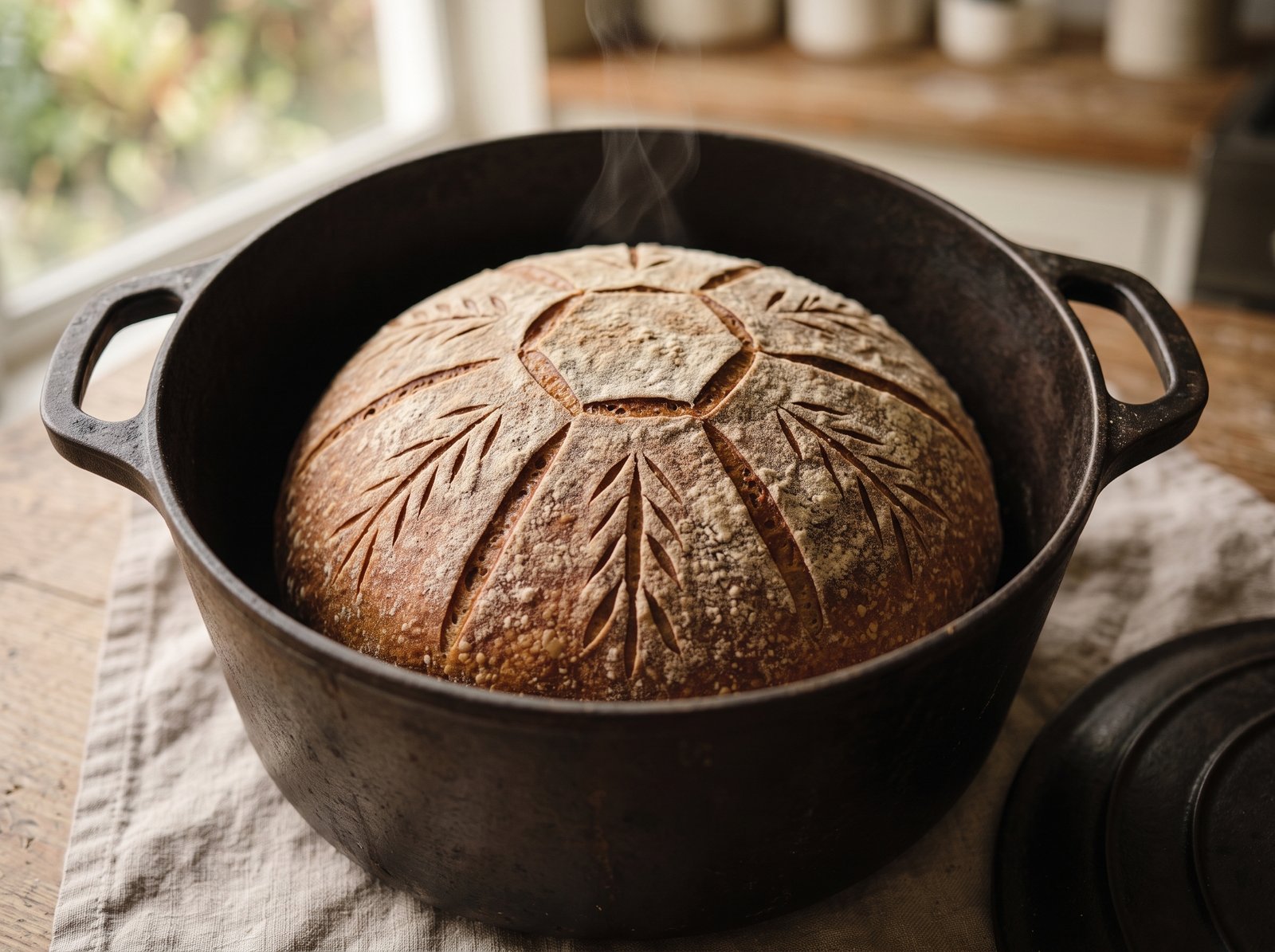
- Turn the cold dough out onto parchment paper and dust the surface lightly with flour so the scoring lines will show up clearly.
- Using the lame, score a small hexagon, about 2 inches across, in the center of the loaf, cutting about ¼ inch deep.
- From the middle of each side of the hexagon, score a straight line radiating outward toward the edge of the loaf, each about ¼ inch deep.
- Partway along each radiating line, add several short diagonal branch cuts angling off to either side, like the arms of a snowflake, to build a lacy, frost-like pattern.
- From each of the 6 corners of the hexagon, extend radiating lines further toward the edge and score it about ½ inch deep - this deeper cut gives the loaf a reliable vent for the oven spring, hidden within the pattern.
- Carefully lower the dough (on its parchment) into the hot Dutch oven, cover, and bake for 20 minutes.
- Remove the lid and bake another 20-25 minutes, until deeply golden and the pattern has bloomed open.
- Cool on a wire rack at least 1 hour before slicing.
Notes
Scoring a design like this is really just scoring with intention instead of one confident slash — the dough doesn't care that the pattern is more complicated, it just needs somewhere reliable to expand.
That's why there's a deeper vent cut tucked into this design and not just decorative lines. A loaf scored only with shallow, pretty cuts and nothing deep enough to actually vent steam is how you end up with a blowout somewhere you didn't plan for.
Go slower than feels necessary on the branch cuts. A hesitant, shaky line reads as messy once it blooms in the oven; a confident, unhurried one reads as lace.