Ingredients
Equipment
Method
- Whisk the starter and ube extract into the 340 g lukewarm water, about 80°F, until fully dissolved and evenly violet.
- Add the flour and ube powder and stir until no dry flour remains. Cover and rest 30 to 40 minutes.
- Add the salt and knead for 5 minutes, until smooth, or squeeze it in and do stretch and folds.
- Stretch and fold: pull the dough up at the side and fold toward the center, rotating to fold every side. Cover and rest 30 minutes.
- Repeat the stretch and fold three more times, for a total of 4 rounds, resting 30 minutes between rounds.
- Bulk ferment 2.5 to 3.5 hours at room temperature, until risen about 50 percent (not doubled).
- Turn the dough out onto a floured surface, fold the top edges in twice to form a loose round, and bench rest 15 minutes.
- Flip the dough, roll into a tight ball to build surface tension, and pinch the seam closed on the bottom.
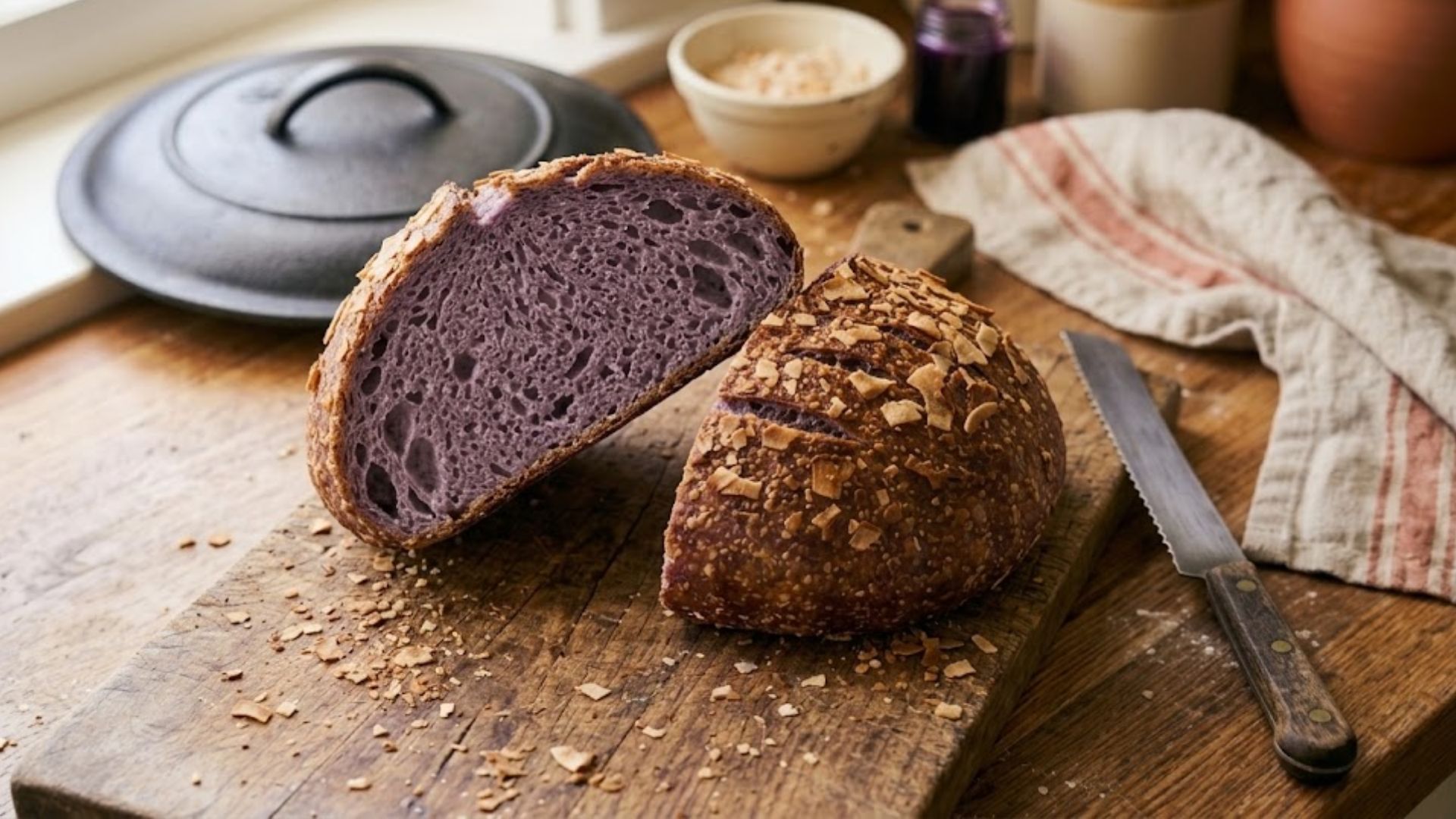
- Mist the smooth top of the shaped dough and press the toasted coconut flakes onto it. Flour the banneton, flip the dough in coconut-side down, pinch the seam on top, and dust with flour.
- Cover and refrigerate overnight, 10 to 16 hours.
- Preheat the oven with the Dutch oven inside to 475°F, about 45 minutes.
- Turn the dough onto parchment, score a leaf-vein pattern about ½ inch deep, transfer to the Dutch oven with 4 ice cubes, and cover.
- Bake covered 30 minutes, then uncovered 15 minutes, until deeply golden.
- Cool on a rack at least 1 hour before slicing.
Notes
Ube extract and ube powder are not interchangeable. Extract alone gives a brighter color but a thinner flavor, and powder alone looks a little muted but tastes more clearly like real ube. Using both gets you color and flavor together.
Keep the coconut on the crust rather than folding it into the dough. Folded in, it turns soft and steamed. Pressed onto the surface, it toasts and stays crisp.