

The 9-to-5 Sourdough Schedule: Baking Around a Full Workday
On This Page
- Why cold-retard is the 9-to-5 baker’s best friend
- The schedule (fill in your own bake time here)
- Where this schedule actually flexes – and where it doesn’t
- The trick that saves you from feeding twice a day forever
- Common failure mode: the starter isn’t ripe when you get home
- How much of this is actually “hands-on”
- Make tomorrow morning even easier
- If your hours don’t look like this example
- A quick FAQ
Somewhere around my third loaf, I remember standing in the kitchen at 11 p.m., shaping dough by the light of the stove hood, and thinking: this is not sustainable. I had a job. I had a commute. I did not have the kind of day where I could “check the dough every hour or so,” which is what approximately every sourdough recipe on the internet assumes you’re free to do.
Here’s the thing nobody tells you when you start: sourdough doesn’t actually need you home all day. It needs you home at two specific moments – mixing and shaping – and everything in between is time the dough spends fermenting whether you’re standing over it or not. Once I stopped trying to babysit it and started building the schedule around my actual hours, the whole thing got a lot less dramatic.
This is that schedule. Not a recipe – you can use it with whatever sourdough recipe you already bake – just the timing logic for fitting a full loaf cycle around a real job.
Why cold-retard is the 9-to-5 baker’s best friend
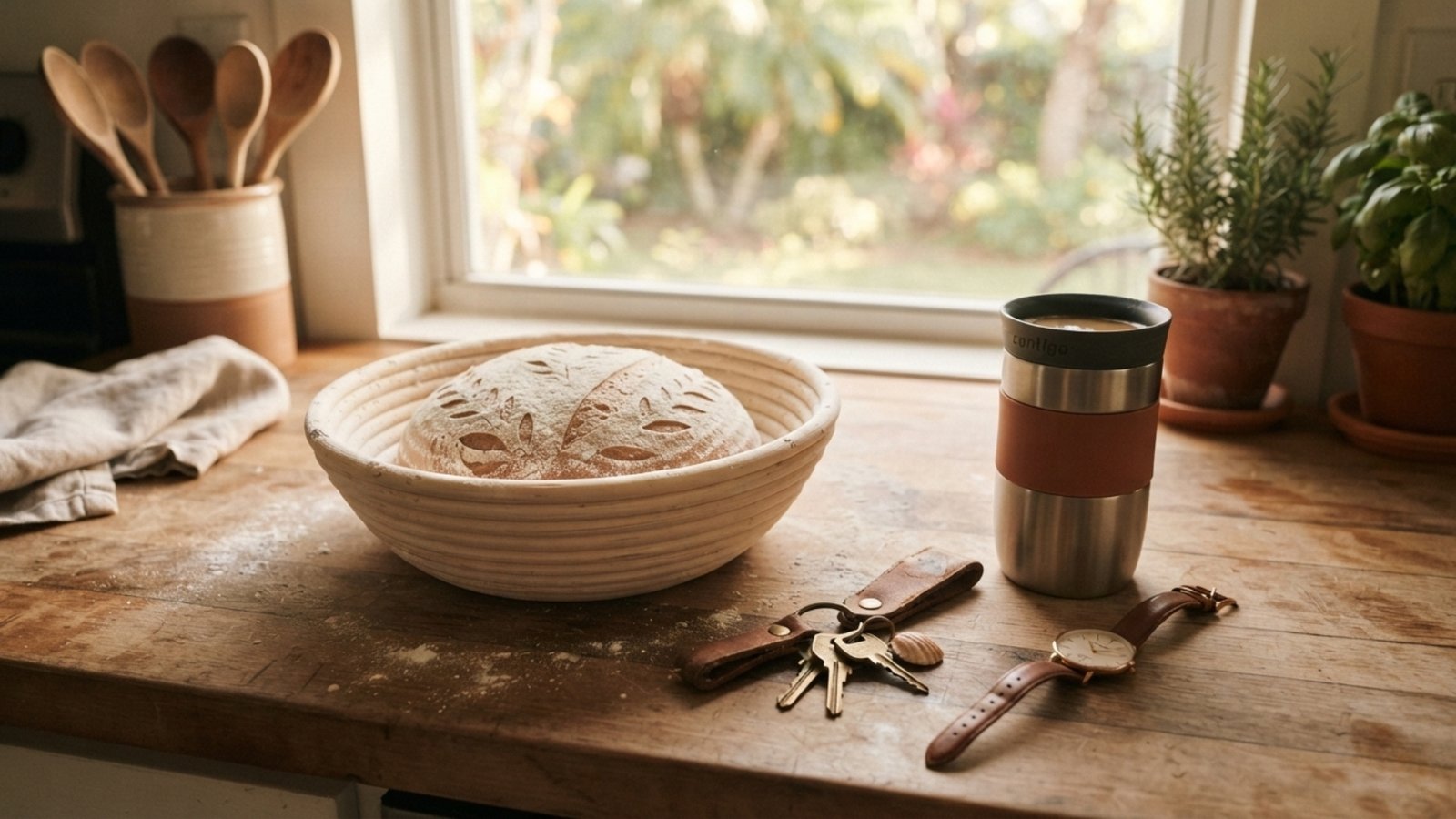
The move that makes this whole schedule work is the overnight fridge retard: shaping your loaf at night and letting it finish its final proof slowly in the refrigerator instead of on the counter. Cold doesn’t stop fermentation, it just puts a foot on the brake – hard enough that a proof which would over-do itself on the counter in 3-4 hours can sit safely in the fridge for 8-14 hours instead.
That’s the exact window a workday leaves you. You shape before bed, the fridge holds the loaf steady while you sleep and commute, and you bake whenever you actually get to it the next day – before work if you’re a morning person, or that evening if you’re not. The fridge is doing the part of the job you can’t: standing around waiting for dough to be ready at 7 a.m. on a Tuesday.
The schedule (fill in your own bake time here)
This example assumes a fairly typical 9-to-5 – out the door by 8, home by 5:30 – and a bake time the next morning before work. Every step below can be dropped straight into the Bake-Day Timeline tab on the Sourdough Calculator: pick your actual bake time and kitchen temperature and it’ll spit out your own version of this table, no mental math required.
| Time | Step |
| 7:00 AM | Feed your starter before you leave for work |
| (at work) | Starter ripens on its own while you’re out |
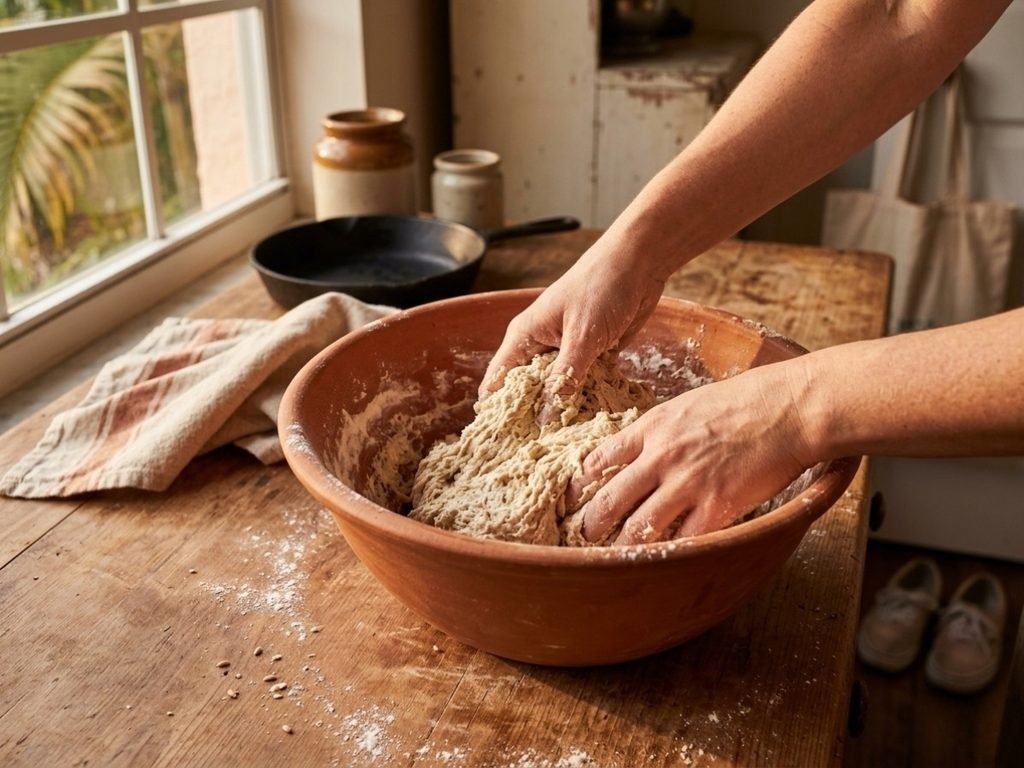
| 5:30 PM | Mix your dough as soon as you’re home |
| 5:30-9:30 PM | Bulk ferment (fold a few times in the first couple hours, then leave it alone) |
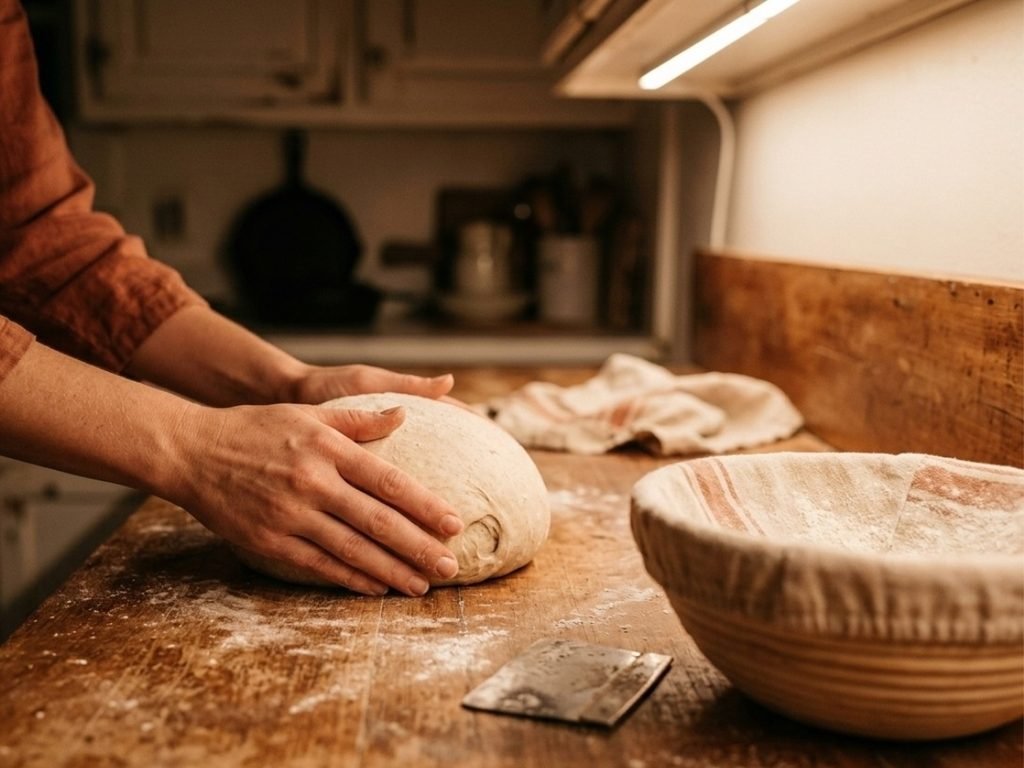
| 9:30 PM | Shape your loaf |
| 9:30 PM-7:00 AM | Final proof in the fridge, covered |
| 7:00 AM | Bake straight from the fridge |
Notice what this schedule does not ask of you: it doesn’t need you to be home at noon, it doesn’t need you to fold dough on your lunch break, and it doesn’t need you to wake up at 5 a.m. to catch a starter at exactly the right minute. The two hard commitments are “mix when you get home” and “shape before bed.” Everything else is dough doing its thing without you.

If you’re not a morning baker, flip the last step. Leave the loaf in the fridge all day, then bake it that evening when you get home, straight from the fridge and into a preheated oven. There’s no need to let it warm up on the counter first. Cold dough is easier to score, holds its shape better, and bakes up just fine. The extra hours in the fridge also give the flavor a little more tang, which I consider a bonus.
Where this schedule actually flexes – and where it doesn’t
Not every step here has the same amount of give, and knowing which is which is what keeps this from feeling like a countdown to disaster if your day runs long.
Generous flex (a few hours, don’t stress it):
- When you feed your starter in the morning – anywhere in your normal “before work” window is fine
- When you leave your loaf in the fridge, it can technically stay there anywhere from 8 to 48 hours. So if something comes up and you can’t bake the next day, the day after works too.
Tighter flex (±30-45 min, worth planning around):
- Mixing time – the later you mix, the later bulk fermentation and shaping push, and the later you’re up
- Shaping time – this is the one step you genuinely have to be present and awake for; don’t schedule it for the exact moment you’d normally be falling asleep
Note
The one thing to actually watch: your starter needs to be ripe (roughly doubled, domed, passing whatever readiness check you use) before you mix. If it’s not ready when you walk in the door at 5:30, mixing early just means the whole rest of the schedule inherits a sluggish start. More on the fix for this below.
The trick that saves you from feeding twice a day forever
Here’s the part of the “sourdough controls my life” complaint that’s really about the starter, not the loaf: a lot of routines assume you’re feeding your starter every 12 hours, indefinitely, whether you’re baking that week or not. You don’t have to live like that.
Keep your starter in the fridge between bakes. A fridge-cold starter can go a week or more without a feeding and still bounce back fine. When you know you’re baking, work backward from the day. Say you want to bake on Tuesday: take your starter out of the fridge on Monday morning and feed it before you leave for work. That evening, mix and shape your dough, then put it in the fridge for its cold ferment. On Tuesday, bake it in the morning or the evening, whichever works better for you. One feed, one bake, back in the fridge. No daily ritual required unless you actually want one.
Common failure mode: the starter isn’t ripe when you get home
This is the single most common way this schedule goes sideways, and it’s almost always about timing the feed, not the starter being “bad.”
If your kitchen runs warm, a starter fed at 7 a.m. might peak by 1 or 2 p.m. and start to fall by the time you’re home at 5:30 – meaning it’s past its best window, not before it. If your kitchen runs cool, the opposite: it might still be climbing at 5:30 and not be ready at all.
The fix is the same either direction: match your starter-to-flour-and-water ratio at feeding to how long you actually need it to hold. A leaner feed (something like 1:5:5 instead of a stronger 1:1:1) stretches out the rise and gives you a wider landing window if your house runs warm. A stronger feed does the opposite if your kitchen is cool and you need it to move faster. This is exactly the kind of adjustment the Bake-Day Timeline tab handles for you once you tell it your kitchen’s temperature range – worth running your numbers through it once so you know your starting point, then adjusting by feel from there.
How much of this is actually “hands-on”
Part of what makes sourdough feel like it’s running your life is that the total timeline is long – 24 hours, start to bake – even though the amount of it that needs your actual attention is small. Worth counting up, because the gap between those two numbers is bigger than it feels in the moment:
- Feeding the starter: 2 minutes
- Mixing the dough: 10-15 minutes
- A few folds early in bulk fermentation: 10 minutes total, spread across the first two hours
- Shaping: 5-10 minutes
- Scoring and loading into the oven: 5 minutes
That’s well under an hour of genuine hands-on time spread across a 24-hour window – the rest is the dough working while you’re at your desk, eating dinner, or asleep. The “controls my life” feeling usually comes from treating the whole 24 hours as time you owe the loaf, rather than recognizing that all but about 40 minutes of it is time the dough spends without you.
Make tomorrow morning even easier
If you’re baking before work, a little night-before prep pays off out of proportion to the effort: set out your baking vessel (Dutch oven, baking stone, whatever you use) the night before so you’re not hunting for a lid at 6:45 a.m., and if you score decoratively, have your lame or sharp blade somewhere you’ll actually find it half-awake. Don’t forget you’ll need 30 min to preheat the oven and 45 min to bake the bread… account for that if you need to rush out the door in the morning. None of this changes the schedule above – it just removes the small frictions that make a fine schedule feel harder than it is at 7 a.m.
If your hours don’t look like this example
Not everyone’s out the door by 8 and home by 5:30, and this schedule isn’t trying to be the one true timeline – it’s trying to show you the shape so you can build your own. The shape is: feed in the morning before you leave, mix as soon as you’re reliably home, bulk ferment through the evening, shape before bed, retard overnight, bake whenever works the next day. Slide the actual clock times to match your job, plug your bake time into the Sourdough Calculator, and let it do the subtraction for you.
A quick FAQ
Can I skip the fridge and just bake same-day after work? You can, but you’ll be baking later at night and with less flavor development than an overnight retard gives you. If a same-day bake fits your life better, that’s genuinely a different schedule with different mechanics – see the next post in this series.
What if I have to work late and miss my mixing window? When you get home, put your activated starter back in the fridge so it doesn’t sit out for too long. The next day, you can use it straight from the fridge to mix your loaf after work. It will still do its job.
Does this work with any sourdough recipe? Yes – this is a timing framework, not a recipe. Use it with whatever loaf you already bake; just swap in your own mix and bulk-fermentation times where relevant.
This is Part 1 of Sourdough on a Real Schedule – a three-part series on fitting sourdough around an actual life, not the other way around. Next up: the same-day and weekend version for when you’re free all day and don’t want to wait overnight, and the Florida-heat version for kitchens where this whole timeline runs faster than written. Or skip ahead to the Bake-Day Timeline calculator and build your own.
Find Your Schedule
This is one of three built-in schedules. Answer three quick questions and see which one actually fits your day.
More Resources
Looking for a printable reference? Browse all six Printable Quicksheets, or dial in your own numbers with the Sourdough Calculator.
Knead to Know?
New recipes, baking tips, and sourdough troubleshooting — delivered before your starter even finishes its next rise.
Get the latest insights, no spam — just new recipes and baking tips. Unsubscribe anytime. See our Privacy Policy.




2 Comments