


The Weekend Sourdough Schedule: Same-Day Bread Without the Overnight Wait
On This Page
The overnight schedule in Part 1 of this series solves the “I have a job” problem. This post solves a different one: it’s Saturday, you’re free all day, and waiting until tomorrow morning to eat bread you could theoretically have by dinner feels like a scheduling failure of its own kind.
Same-day sourdough is real, it’s not a trick, and it’s not “not really sourdough” – it’s the same fermentation, just pushed to move faster on purpose. Here’s how, and here’s honestly what you’re trading away to get it.
What actually changes to make same-day work
Three levers move the whole timeline, and you don’t need all three at once – but stacking them is what gets you from an 18-hour process down to something that fits inside a Saturday.
A bigger starter feed. Instead of your normal ratio, feed with more starter relative to flour and water – something closer to 1:2:2 instead of a leaner everyday feed. More active culture in the mix means fermentation gets a running head start instead of waiting for a smaller population to build up.
A warmer bulk ferment. This is the biggest single lever. Fermentation roughly doubles in speed for every 15-17°F you add, within reason – so a bulk that takes 4-5 hours at a cool 70°F might take half that around 80-82°F. An oven with just the light on, a turned-off oven that was recently warm, or a proofing box are the usual tools; even a warm spot near a sunny window works in a pinch.
No cold retard. The whole move in Part 1 was using the fridge to slow things down for a full workday. Here we do the opposite – skip the fridge stage entirely and let the final proof happen at room temperature too, just watched more closely since it moves faster.
The schedule (start after breakfast, bake before dinner)
This example starts late morning and lands in the late afternoon – built for someone who’s home and around, not standing over the dough the whole time, just checking in more often than the overnight schedule requires.
| Time | Step |
| Night before | Feed your starter before bed with a slightly larger ratio than usual |
| 8:00 AM | Starter should be ripe and ready first thing |
| 8:30 AM | Mix your dough |
| 8:30 AM-12:30 PM | Bulk ferment in a warm spot (check in every 45 min-1 hr rather than leaving it all day) |
| 12:30 PM | Shape your loaf |
| 12:30-2:30 PM | Final proof at room temperature, in a warm spot |
| 2:30 PM | Bake – bread’s out well before dinner |
As with the 9-to-5 schedule, run your own bake time through the Bake-Day Timeline tab – same-day compresses hard enough that even an hour’s difference in your kitchen’s actual temperature shifts this table meaningfully, and the calculator does that math faster than eyeballing it.

The honest tradeoff: flavor and texture
This is the part competitor same-day posts tend to gloss over, and it’s worth saying plainly: an overnight cold retard doesn’t just exist to fit your schedule – it also gives the dough more time to develop the deeper, more complex sour flavor and slightly more open crumb that a lot of bakers specifically bake sourdough for. Same-day bread is genuinely good bread. It’s also genuinely milder and a little less structurally dramatic than the same recipe given a full overnight rest. Neither is “correct” – it’s a real tradeoff, not a hack with no downside, and it’s worth knowing that going in rather than being disappointed when a same-day loaf doesn’t taste like your usual overnight one.
If you want most of the speed with more of the flavor, a middle option: do a short 2-3 hour cold retard instead of skipping it entirely. Even a couple hours in the fridge nudges the flavor further along without blowing your same-day timeline.
A few more levers, if three isn’t enough
The starter ratio, warmth, and skipped retard above will get most kitchens to a same-day bake. If you’re still running long, a few more adjustments stack on top:
Warmer mixing water. Using water on the warmer side (roughly 85-90°F rather than straight from the tap) gives the whole mix a head start without changing anything about the flour or the starter itself. Don’t go hotter than that – you can kill off yeast activity instead of encouraging it if the water’s genuinely hot rather than warm.
A slightly lower hydration. Wetter doughs ferment a touch faster but also hold their shape less well under a rushed timeline. Nudging hydration down slightly from your usual recipe trades a little of that speed for a dough that’s more forgiving to shape and less likely to spread if you end up baking it a bit under- or over-proofed.
Bread flour over all-purpose, if you have a choice. More protein means more structure to work with, which matters more on a compressed timeline where you have less margin to recover from a slightly rushed shape.
None of these are required – the three core levers (starter ratio, warmth, no retard) do the real work. These are for squeezing out another 30-60 minutes if your day’s tighter than the example schedule assumes.
Making a whole day of it
Same-day baking has a different rhythm than the overnight schedule, and it’s worth leaning into rather than treating it as just a faster version of the same thing. Because you’re around and checking in every 45 minutes to an hour instead of setting it and walking away for 12 hours, it’s genuinely a better fit for baking with kids, for a slower weekend where the kitchen is the plan rather than a chore squeezed into one, or for the first few times you bake a new recipe and actually want to watch what the dough is doing at each stage rather than trusting a schedule you haven’t tested yet.
What if it’s not ready by your bake time
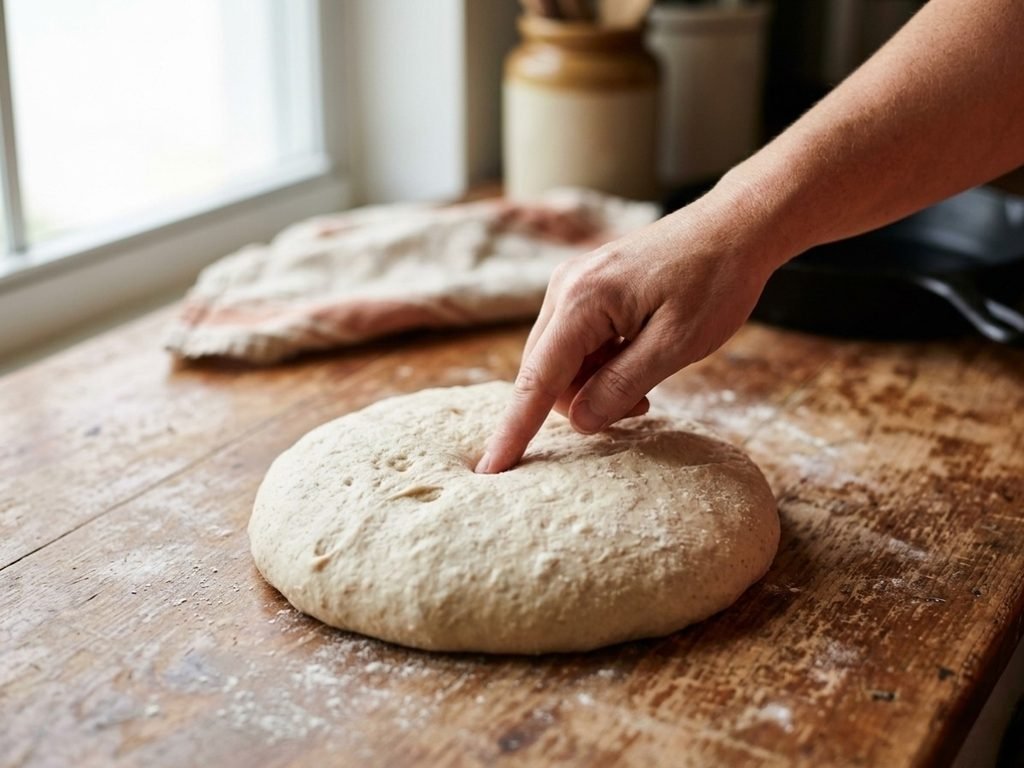
Same-day schedules have less margin than overnight ones, so it’s worth having a plan for when the dough runs behind. If bulk fermentation is taking longer than the table above by more than 30-45 minutes, the most common cause is a bulk spot that’s not actually as warm as it feels – double check with an actual thermometer rather than your hand, and move it somewhere warmer rather than just waiting longer at the same temperature. If you’re genuinely out of runway before dinner, it’s better to let shaping and final proof run a bit long in a cooler spot than to rush the bake on underproofed dough – a same-day loaf that goes in an hour “late” is still a good loaf; one that goes in underproofed usually isn’t.
When same-day is the wrong call
A same-day push works best when your kitchen actually cooperates – you have a genuinely warm spot to proof in, and you’re going to be around to check on the dough rather than leaving it to guess for itself. If your kitchen runs cool and you don’t have a reliable warm spot, forcing a same-day timeline usually means underproofed dough rushed into the oven because the clock said it was time, not because the dough said so. In that situation, the overnight schedule in Part 1 will get you a better loaf with less fuss – same-day isn’t inherently better, it’s a different tool for a different day.
Note
If your kitchen already runs hot – genuinely hot, not just “warm room” hot – you may find you’re getting a same-day timeline by accident even when you planned for overnight. That’s not a mistake, it’s just what heat does to fermentation. The next post in this series is built entirely around that situation.
A quick FAQ
Do I need commercial yeast to make same-day work? No – this is pure sourdough fermentation sped up through starter ratio and temperature, not a shortcut using added yeast. If you want it faster still, adding a small amount of commercial yeast alongside your starter is a separate technique some bakers use, but it changes the flavor profile more than the adjustments above do.
Can I do this on a weeknight instead of a weekend? Yes, if you’re home during the day – the schedule above just needs someone around to mix mid-morning and check on bulk fermentation through the afternoon, which is easier on a day off but not exclusive to one.
My same-day loaf came out denser than my overnight one. Did I do something wrong? Probably not – see the flavor/texture tradeoff above. A slightly denser, milder loaf is the expected result of a compressed timeline, not a sign of a mistake, unless it’s dramatically flat or gummy, which points to underproofing instead.
Can I use this same approach for enriched or sweeter sourdough doughs? The same three levers apply, but enriched doughs (butter, eggs, sugar) ferment more slowly than a lean loaf to begin with, so expect the whole timeline to run longer than the table above even with every adjustment stacked on.
This is Part 2 of Sourdough on a Real Schedule. If your weekdays need a different shape than this one, see the overnight 9-to-5 schedule in Part 1. And if your kitchen runs hot enough that “same-day” happens whether you plan for it or not, Part 3 covers how Florida heat compresses this whole timeline – including how far past this post’s numbers a genuinely hot kitchen can go.
Find Your Schedule
This is one of three built-in schedules. Answer three quick questions and see which one actually fits your day.
More Resources
Looking for a printable reference? Browse all six Printable Quicksheets, or dial in your own numbers with the Sourdough Calculator.
Knead to Know?
New recipes, baking tips, and sourdough troubleshooting — delivered before your starter even finishes its next rise.
Get the latest insights, no spam — just new recipes and baking tips. Unsubscribe anytime. See our Privacy Policy.

One Comment