
Cottage Bakery Hub: Packaging, Florida Labels, and a Pricing Worksheet
Everything that changes the day someone hands you money for a loaf. Packaging that survives wet air, what Florida requires on the label, a pricing worksheet that includes your time, and the small kit that gets you through a farmers market morning.
Some links on this page are affiliate links. As an Amazon Associate I earn from qualifying purchases. If you buy through a link I may earn a small commission at no extra cost to you. Full disclosureSelling bread from a home kitchen in Florida is one of the more accessible small businesses there is, and it is also the point where a hobby collects a few real obligations: a label that says specific things, a scale that is accurate in a specific way, and a price that covers your Saturday. This hub is the practical layer on top of the baking. I run a small cottage operation out of the same South Florida kitchen the recipes come from, and I have spent enough of my life around spreadsheets that the pricing section is the part I care about most. One caveat up front: the legal details below reflect Florida’s cottage food rules as I understand them at the time of writing. Rules change, so confirm anything that matters with the Florida Department of Agriculture and Consumer Services (FDACS) before you rely on it, and talk to your own tax professional about the money side.
This page is general information, not legal, tax or accounting advice; cottage food rules vary by state and locality and change over time, so confirm the current requirements with FDACS (or your own state's agency), your county and city, and a licensed professional before you sell. The dollar figures on this page are illustrations only; your costs and prices will differ. Full disclaimer
Florida Cottage Food Rules in One Section
Florida’s cottage food law (Florida Statutes section 500.80) lets you make and sell certain low-risk foods from an unlicensed home kitchen without a permit or an inspection, as long as you follow its conditions. Bread, rolls, cookies, cakes without perishable fillings, crackers, granola and similar shelf-stable baked goods are in. Anything that needs refrigeration to stay safe (cream cheese frostings, custards, cheesecakes) is out. Sales must be direct to the consumer: in person at your home, a farmers market, a roadside stand or an event, or online and by mail or delivery within Florida. No wholesale, no selling through a shop or restaurant. Gross sales are capped at $250,000 a year. Local governments are prohibited from regulating cottage food operations beyond the state law, which is why your county cannot require its own permit for the baking itself, though a county or city business tax receipt for operating any business from home is a separate question worth a call to your tax collector’s office. Your kitchen must be in your residence, and pets are not allowed in the kitchen while you are producing food.
What Has to Be on a Florida Cottage Food Label
Every product you sell has to carry a label with: the name and address of your cottage food operation; the name of the product; the ingredients, in descending order by weight; the net weight or net volume; allergen information as required by federal law (wheat is one of the major allergens, so every loaf declares it, along with milk, eggs, soy, tree nuts, peanuts, fish, shellfish and sesame where they appear); any nutrition information if you make a nutritional claim; and the statement, in at least 10-point type, “Made in a cottage food operation that is not subject to Florida’s food safety regulations.” That exact sentence, every time. Ingredients means everything, including the flour, water and salt inside your starter, and “sourdough starter (flour, water)” is a reasonable way to write it. The net weight is where the legal-for-trade scale comes in: state a weight the loaf will always meet, weighed on a certified scale, because net weight is a minimum.
| Label element | Example |
|---|---|
| Operation name and address | The Bake-Keeper, LLC, 123 Example Street, Anytown, FL 33xxx |
| Product name | Plain Sourdough Loaf |
| Ingredients, descending by weight | Bread flour (wheat), water, sourdough starter (wheat flour, water), sea salt |
| Net weight | Net Wt 28 oz (794 g) |
| Allergens | Contains: Wheat |
| Required statement, 10-point or larger | Made in a cottage food operation that is not subject to Florida’s food safety regulations. |
| Optional but useful | Baked on (date); best within 2 days, freeze after; website |
Label requirements are summarised here as I understand them at the time of writing. Confirm the current FDACS label rules, including the exact wording of the required statement, before you print.
Printing labels in a humid kitchen has its own rule: use a laser printer or a thermal label printer, not an inkjet. Inkjet labels smear the first time a damp loaf bag touches them. Standard 2 by 4 inch and 3 by 4 inch sheet labels fit a bread bag. A small thermal printer (the DYMO and Brother desktop units) is faster once you are past a dozen loaves a week and prints a crisp, waterproof-enough label with no ink to run.
Packaging That Works in Wet Air
The packaging question here is the storage question from how to store sourdough in a humid climate, with a customer on the other end. A crusty loaf bagged in plastic steams itself soft in an hour and can show mold within two days in a customer’s kitchen, and they will blame the bread. So: cool completely, a minimum of two hours and ideally three for a big loaf, before anything goes near it. Bag in paper. A kraft bread bag with a compostable PLA window is the standard. It shows the loaf, breathes, and takes a label on the flat panel. Tin-tie or fold-over tops rather than sealed. For delivery or a longer drive, the paper bag goes into a cardboard bakery box, never a plastic tub. Enriched breads and rolls, which want to stay soft, can go in a clear bag once fully cool.
Tell the customer what to do next, on the label or a small card: “Best within two days. Store cut side down on a board, then slice and freeze.” Customers who freeze come back. Customers who find mold on day three do not. A sticker that says “Baked (date)” on every bag costs nothing and settles a lot of conversations.
The Pricing Worksheet
Most home bakers price a loaf by looking at what the farmers market down the road charges. That is the last step, not the first. Price from your costs up, then look at the market, then decide what to do about the gap. The worksheet below is per loaf. Run it once for your standard loaf and once for anything enriched or seeded. Ingredient costs come straight from your receipts divided by package weight. The Sourdough Calculator gives you the gram amounts.
| Line | How to work it out | Example (900 g plain loaf, batch of 4) |
|---|---|---|
| Flour | grams used divided by grams per bag, times bag price | 500 g bread flour at $8 per 2,268 g bag = $1.76 |
| Starter flour | flour fed to build the levain for this loaf | 100 g = $0.35 |
| Salt, water, extras | small, but write it down | $0.10 |
| Inclusions | seeds, cheese, fruit at actual cost | $0.00 for plain; often $1.50 to $3 for seeded or cheese |
| Packaging and label | bag plus label plus sticker | $0.55 |
| Energy | oven time; a fair estimate is $0.40 to $0.80 per loaf, less when you bake several per preheat | $0.50 |
| Direct cost per loaf | sum of the above | $3.26 |
| Labor | active minutes per loaf (mixing, shaping, scoring, bagging, selling) times the hourly rate you would accept from someone else | 20 minutes at $20 per hour = $6.67 (a batch of 4 shares the mixing time; a single loaf is closer to $12) |
| Overhead | monthly costs that exist because you sell (market fee, insurance, website, equipment wear, mileage) divided by loaves sold per month | $120 per month over 80 loaves = $1.50 |
| Full cost per loaf | direct plus labor plus overhead | $11.43 |
| Target margin | price = full cost divided by (1 minus margin); 20 percent is a modest start | $11.43 divided by 0.80 = $14.29, call it $14 |
Example figures only. Your ingredient, packaging and labor costs will differ; use your own receipts.
Three things jump out of that table every time I run it with someone. Ingredients are not the cost. Your time is. A loaf that sells for $10 with $3 of ingredients feels like a $7 profit and is actually paying you under $8 an hour once overhead is in. Batch size is the lever: the mixing and the preheat cost the same for four loaves as for one, so a Saturday of twelve loaves prices very differently from a Saturday of three. And inclusions are where small bakers quietly lose money. A cheese and jalapeno loaf with $2.50 of extras priced $1 above the plain loaf is a discount, not a premium. Reprice seeded and enriched loaves from their own worksheet, not by adding a dollar.
Then look at the market. If your full-cost price lands above what your area pays, you have four honest options: bake in bigger batches to spread the labor, cut active minutes with equipment (this is the point where a stand mixer or a baking steel for multi-loaf bakes pays for itself), raise the perceived value with a better bag and a story card, or accept a thinner margin for a season while you build regulars. The one option I would not take is pretending the labor line is zero.
Money and Paperwork, Briefly
Keep the bakery money separate from the household money from the first loaf: a separate checking account, every ingredient receipt photographed, every sale logged, even the cash ones. Income from a cottage bakery is taxable income and is reported, and a clean record of costs is what makes the deductions real. Florida treats most bakery products sold for consumption off the premises as exempt from sales tax, but the line between a grocery item and a prepared food is one you should confirm for your specific products and sales setting rather than assume. A single-member LLC gives you a business name and some separation. It does not replace insurance, and a basic product liability policy for a food business is inexpensive enough that it belongs in the overhead line above. None of this is legal or tax advice for your situation. It is the list of questions to bring to your own advisor.
The Farmers Market Kit
What actually comes out of the car at 6:30 on a Saturday: a folding table and a cloth, a pop-up canopy with weights (the wind is not optional here), wooden crates or a tiered rack so the loaves are visible, the loaves already bagged and labeled, a small chalkboard with prices, a card reader and a cash box with change, a printed copy of your labels and your cottage food statement in case anyone asks, bread knife and board for samples with a lidded container for the cut loaf, a roll of paper towels, hand sanitizer, a cooler with cold water for you, and a sign-up sheet or a QR code for your newsletter, because the second sale is the one that makes the business. Pre-orders through a simple online form, picked up at the market, are the single biggest reduction in wasted loaves. It is how our own local pickup works.
Gear for sellers
The three equipment guides that matter once you are selling: a scale you can label with, storage that survives a Florida week, and the full tiered list.
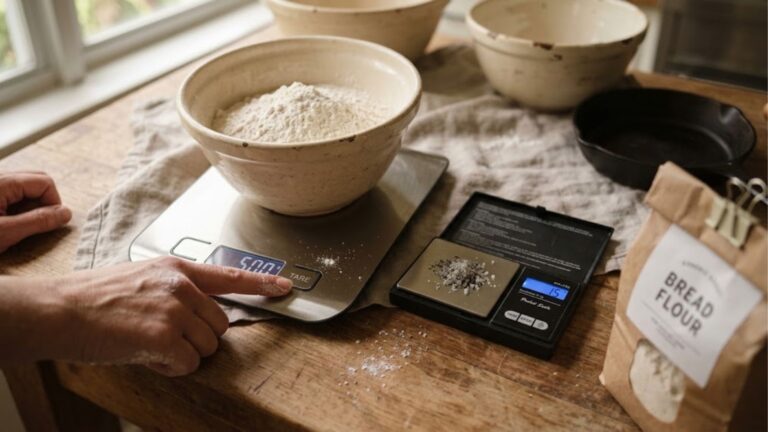
Kitchen Scales for Sourdough
The two-scale setup, the auto-off problem, and legal-for-trade scales for sellers.
Read the guide →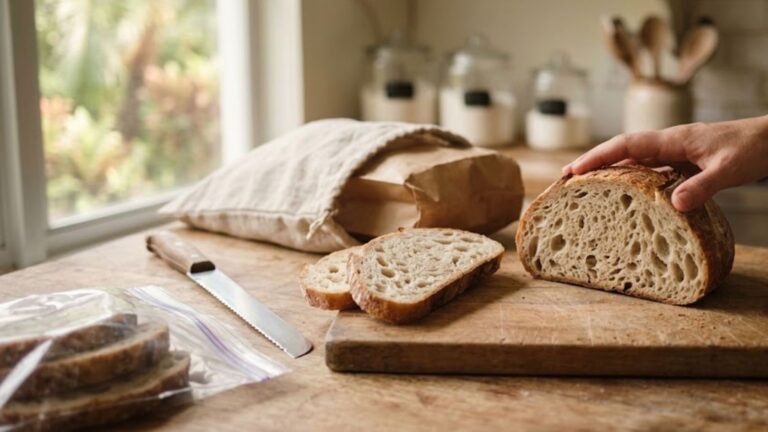
Storing Sourdough in a Humid Climate
Keeping crust and crumb mold-free in wet air, plus the bread knife that does not crush it.
Read the guide →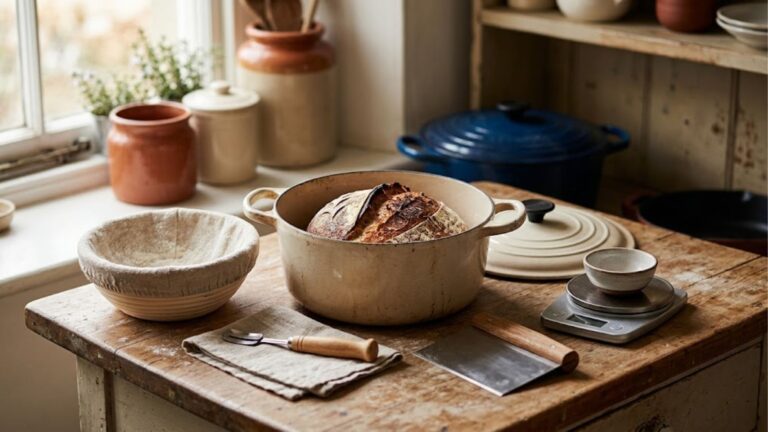
Sourdough Equipment Guide
The full tiered list: what to buy first, what to skip, and the Dutch oven size table.
Read the guide →Keep Going
The equipment that matters once you bake for other people is Tier 3 of the Sourdough Equipment Guide. The scale question is answered in full in Kitchen Scales for Sourdough. For a baking schedule that fits around a job, start with the 9-to-5 sourdough schedule and the Schedule Finder, and for the climate side of running batches in a warm kitchen, Sourdough in a Hot, Humid Kitchen.