
Kitchen Scales for Sourdough: The Two-Scale Setup, Auto-Off, and Legal-for-Trade Scales for Sellers
A scale is the cheapest upgrade in baking and the one most people buy once and never think about again. Here is what to look for, why I keep two, and what changes the day you start selling bread by weight.
Some links on this page are affiliate links. As an Amazon Associate I earn from qualifying purchases. If you buy through a link I may earn a small commission at no extra cost to you. Full disclosureEvery recipe on this site is in grams because cups lie. A cup of flour can weigh anywhere from 120 to 150 grams depending on how it was scooped and how humid the day is, which is a 25 percent swing in the one ingredient that controls everything else. A $15 scale fixes that permanently. The questions worth spending five minutes on are which features actually matter, whether you need a second, finer scale (I think you do), and what “legal for trade” means if you plan to sell.
What Matters in a Bread Scale
Capacity first: you want at least 5 kilograms (11 pounds), because you will weigh into a mixing bowl that already weighs a kilo and a double batch of dough runs past two more. Resolution of 1 gram is fine for flour, water and dough. A tare button you can hit with a floury knuckle. A platform big enough that a wide bowl does not cover the display. This rules out a lot of slim designs. A flat, wipeable top with no seams, because sticky dough and crevices do not mix. And, the one nobody checks until it bites them, an auto-off you can disable or that waits at least five minutes. More on that below. Battery type is a minor point, but AAA beats a coin cell for a scale you use three times a week. Coin cells die at the worst moment and fewer stores carry them.
The Auto-Off Problem
Most kitchen scales switch themselves off after one to three minutes of a stable reading. That is fine for weighing a banana and a disaster for autolyse: you weigh the flour, pour the water slowly, stop to scrape the bag, and the scale goes dark with 300 grams of water already in the bowl and no idea how much more to add. Look for a scale with a long or adjustable auto-off (five minutes or “never” in the settings), or one that resets its timer whenever the weight changes. Failing that, learn the workaround: weigh each ingredient into a separate container first, then combine. It is slower and it is what most of us did for years, but it is also why so many bakers end up with two scales within a season.
The Two-Scale Setup
Here is the setup I actually use and recommend. A 5 kilogram, 1 gram scale on the counter for flour, water, dough and everything bulk. And a small 0.1 gram pocket scale (sometimes sold as a jewelry or coffee scale, 500 gram capacity is plenty) in the drawer for the small amounts where 1 gram resolution is not good enough. Salt is the obvious one: at 2 percent of flour weight, a 500 gram loaf wants 10 grams of salt, and a 1 gram scale that rounds to 9 or 11 is a 10 percent error in the ingredient you taste most. Starter for a small build (say 15 grams into a 1:5:5 feed), instant yeast for enriched doughs, diastatic malt, and the half-teaspoon of this and that in the mix-in ratios guide all live in the same territory. A good 0.1 gram scale costs less than a bag of fancy flour, and it is also the right tool for the tiny inoculations that keep a starter slow in a hot kitchen. The cheap pocket scales are often perfectly accurate at the low end. What you are paying for in a pricier one is a bigger platform and a case that survives flour.
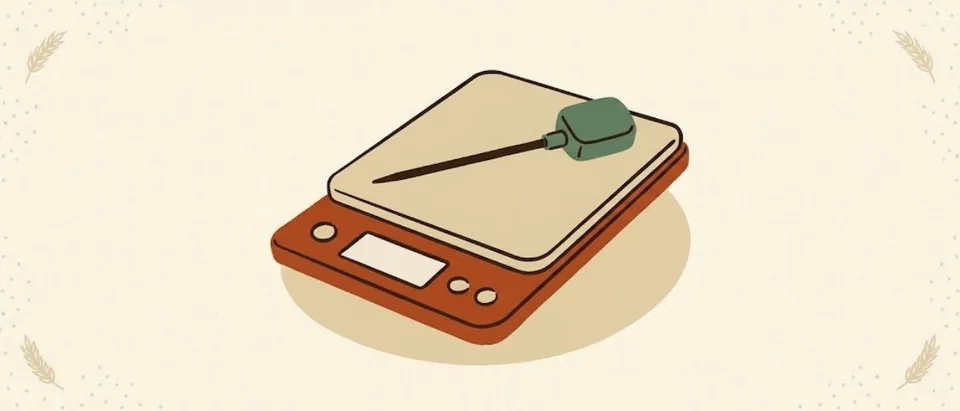
Scales: pocket, counter and premium
A pocket scale reads to a tenth of a gram for salt and yeast. The everyday counter scale has one gram resolution, 5 kg capacity and a flat top you can wipe. The premium ThermoWorks scale reads to 0.1 gram, so one platform handles both jobs.
Desi Recommends
Pocket Digital Scale (0.1g precision)
- 0.1 g precision
- Digital
A small scale that reads to a tenth of a gram, for salt, yeast and starter feeds that a one gram scale cannot measure. Keep it next to your counter scale.
Desi Recommends
Digital Kitchen Scale (1g precision)
- 1 g precision
- Digital
Baking by weight is the single biggest upgrade for consistent results, and a simple 1 g scale like this one covers nearly every home loaf.
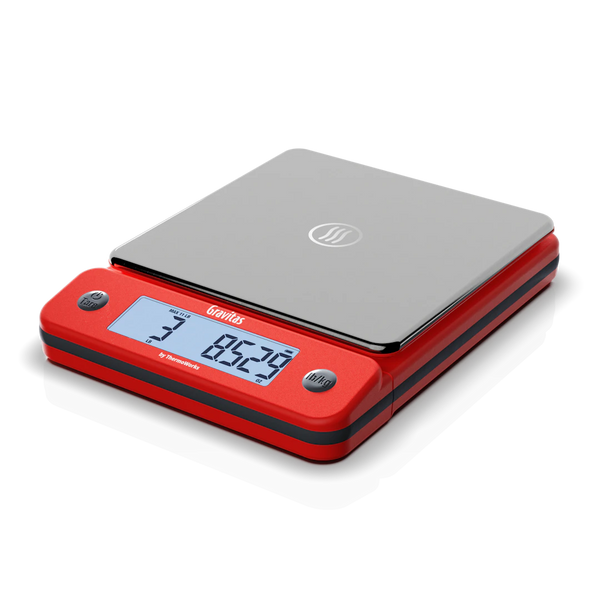
ThermoWorks Gravitas Precision Kitchen Scale
Weighs to the tenth of a gram with ±0.7 g accuracy, and its detachable backlit display means a big mixing bowl never hides the reading. A premium step up from a basic scale for anyone who bakes by weight.
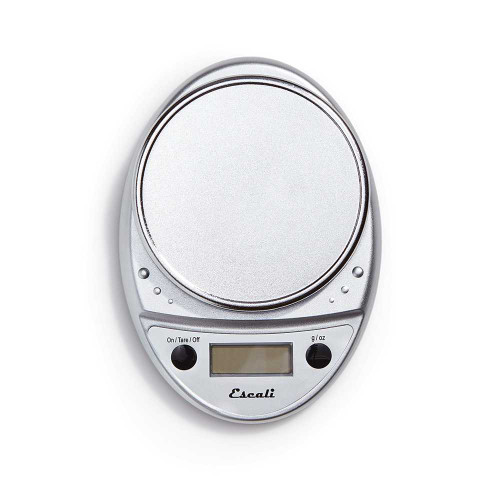
Essential Digital Scale
A straightforward digital scale for weighing flour, water and starter in grams. Weighing instead of scooping is the single biggest upgrade for consistent bread, and this one keeps it simple.
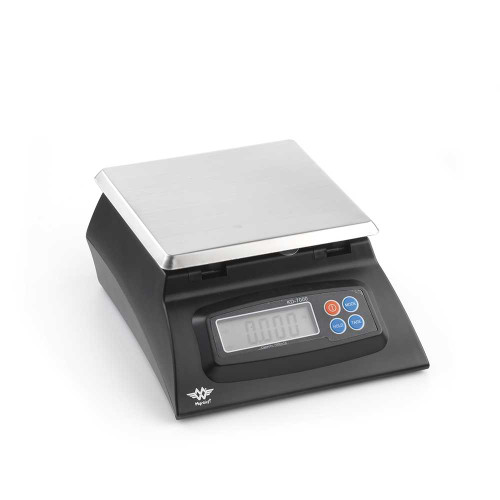
KD-7000 Digital Scale
A step-up kitchen scale for bakers who want more capacity and precision than a basic model, handy for big batches and for small amounts like salt and yeast. The upgrade pick if the basic scale starts to feel limiting.
Keeping a Scale Honest in a Humid Kitchen
Humidity won’t change how a scale weighs, yet it will shorten its life. Condensation forms inside a scale that moves from a cold cabinet to a warm counter, and that corrodes the contacts and makes readings drift or flicker. Keep the scale in a drawer at room temperature rather than a cabinet against an exterior wall, wipe it dry after each use, and take the batteries out if you will not bake for a month. Check it twice a year with something of known weight: a new, sealed bag of flour is close enough for a 1 gram scale (a 5 pound bag should read within a few grams of 2,268), and a US nickel weighs 5.00 grams for the pocket scale. If a scale reads differently when you move the bowl to the edge of the platform, it is on its way out.
Selling Bread by Weight: What “Legal for Trade” Means
This is the part no baking blog covers and the part that matters the moment you sell a loaf. If you sell by count (“one loaf, $12”) your kitchen scale is nobody’s business but yours. If you sell by weight, or your label states a net weight (and under Florida cottage food rules it must), the scale that produces that number is, in weights-and-measures terms, a commercial device. In the United States that generally means a scale that is NTEP certified (the National Type Evaluation Program run under the National Conference on Weights and Measures) and sold as “legal for trade,” usually a Class III device. NTEP scales are built and sealed so they cannot be casually recalibrated, display in units a customer can read, and have a resolution appropriate to their capacity. Depending on your state, a commercial scale may also need to be registered with or inspected by the state’s weights-and-measures office. In Florida that is the Department of Agriculture and Consumer Services, Bureau of Standards, and the rules for a very small cottage operation are worth a phone call rather than a guess.
Practically: a legal-for-trade bench scale with a 15 to 30 pound capacity costs roughly what a mid-range stand mixer attachment does, it is a one-time purchase, and it protects you in the one situation where a customer or an inspector questions a label. Use it for the net-weight number on your labels and for any by-the-pound pricing. Keep using the kitchen scale for the recipe itself. Nobody needs an NTEP seal to weigh flour. If you only ever sell by the loaf and your labels state a weight, weigh a few loaves from each batch on the certified scale and label at or slightly under the lightest, since net weight is a minimum, not an average. The Cottage Bakery Hub covers labels, packaging and pricing together.
| Job | Scale | Resolution | Capacity | Notes |
|---|---|---|---|---|
| Flour, water, dough, bulk ingredients | Counter kitchen scale | 1 g | 5 kg or more | Long auto-off, big flat platform, tare |
| Salt, small starter builds, yeast, malt | Pocket scale | 0.1 g | 500 g | Keep it in a drawer, check with a nickel (5.00 g) |
| Net weight on a label, selling by the pound | Legal-for-trade bench scale | Typically 0.005 lb / 2 g | 15 to 30 lb | NTEP certified, Class III; check state registration rules |
Weights-and-measures rules are set and enforced locally. Whether your scale must be certified, registered or inspected depends on how you sell and where; confirm with the FDACS Bureau of Standards or your own state's weights-and-measures office before relying on it for labels.
A Few Habits That Make the Scale Worth It
Weigh water, do not measure it. A gram of water is a milliliter, and the scale is faster than a jug. Tare between every ingredient and add them straight to the bowl in the order the recipe lists. Write your dough weight on the recipe card once (the Sourdough Calculator will do it for you) so you can pick the right banneton and divide evenly for two loaves. And weigh your finished loaves now and then. A loaf that comes out 12 to 15 percent lighter than its dough weight baked properly, and one that is only 8 percent lighter probably has a gummy middle.
More gear guides
The rest of the equipment series, one decision per guide.
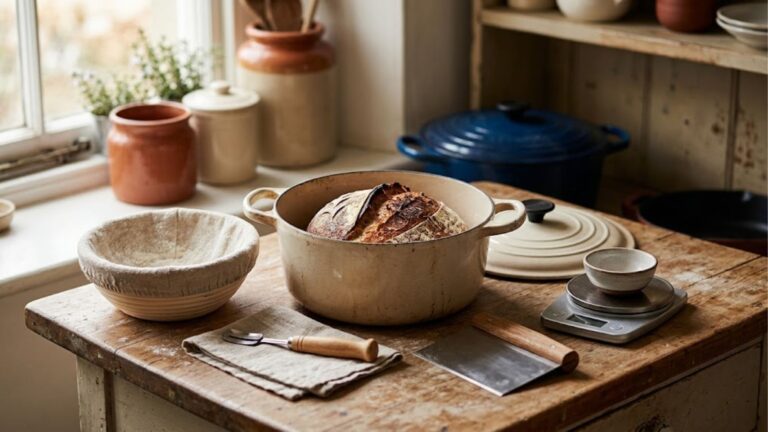
Sourdough Equipment Guide
The full tiered list: what to buy first, what to skip, and the Dutch oven size table.
Read the guide →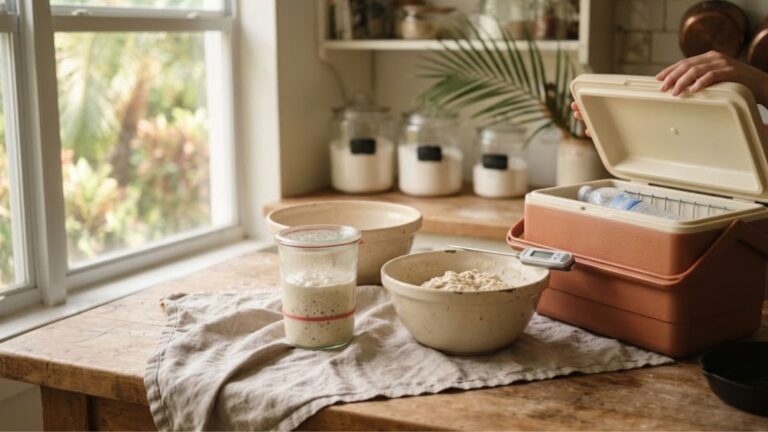
Sourdough in a Hot, Humid Kitchen
What changes when your kitchen is 79 degrees, and the gear that actually helps.
Read the guide →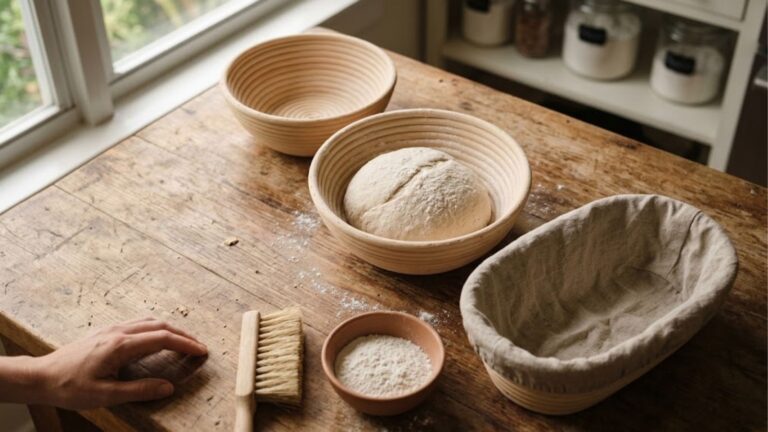
Banneton Sizing and Care
Size chart by dough weight, liners, and keeping mold out in wet air.
Read the guide →
Scoring Tools
UFO vs straight lames, left-handed options, and scoring sticky summer dough.
Read the guide →
Starter Jars and Climate Control
The right jar, and why a Florida kitchen shops for cooling, not warming.
Read the guide →
Storing Sourdough in a Humid Climate
Keeping crust and crumb mold-free in wet air, plus the bread knife that does not crush it.
Read the guide →
Pizza Stone vs. Baking Steel
Which one actually belongs in your oven, tested side by side.
Read the guide →Keep Going
For baker’s percentages and converting a cup recipe to grams, see the printable quicksheets. For the rest of the tools, in order of how much they matter, the Sourdough Equipment Guide. For everything that changes in a warm kitchen, Sourdough in a Hot, Humid Kitchen.