
Sourdough in a Hot, Humid Kitchen: The Equipment That Actually Helps
Most sourdough gear guides are written for cold kitchens. Mine is 79 degrees in October. Here is what changes when your problem is too much warmth instead of too little, and the handful of tools that actually earn a spot on a South Florida counter.
Some links on this page are affiliate links. As an Amazon Associate I earn from qualifying purchases. If you buy through a link I may earn a small commission at no extra cost to you. Full disclosureEvery starter warmer, proofing box and “cozy spot on top of the fridge” tip you have ever read was written by someone whose dough was cold. If you bake anywhere along the Gulf Coast, in a Florida condo with the air conditioning set to “polite,” or in any kitchen that lives above 76 degrees F for half the year, your dough has the opposite problem. It is never slow. It is in a hurry, it is sticky, and the moment you look away it is overproofed. Humidity piles on: flour drinks moisture out of the air, bannetons grow fuzz, and a loaf that would last four days in Vermont goes soft in two.
None of that needs a shopping spree. It needs a thermometer, a fridge you are willing to use on purpose, and a few habits around storage. This guide walks through what heat and humidity actually do to each stage of a bake, what I use to deal with it, and what I would skip. If you want the day-by-day timing that goes with it, the Florida heat sourdough schedule and the Schedule Finder do that part.
What Heat and Humidity Actually Do to Your Dough
Two separate things are happening, and it helps to keep them apart. Heat changes speed: roughly speaking, every 3 to 4 degrees F of dough temperature shaves 15 to 20 percent off your fermentation time, so a bulk that takes six hours at 72 degrees can be done in under four at 80. That is why “proof until doubled, about 8 hours” recipes blow up on us. Humidity changes materials: flour sitting in an open bag absorbs water and ferments faster and stickier than the recipe expects. Wet rattan does not dry between bakes and molds. A crust that should stay crisp pulls moisture back out of the air and softens by the next morning. The thermometer handles the first problem. Storage habits handle the second. I covered the fermentation side in depth in hydration and climate: the two numbers that control your fermentation time, so this page stays on the gear.
The One Tool That Matters Most: A Thermometer You Actually Use
If you buy one thing after reading this, make it an instant-read thermometer, and then use it on the dough, not just the finished loaf. Dough temperature is the number that predicts how fast your bulk will move. In a warm kitchen it is the difference between a loaf with an open crumb and a flat, sour puddle. I take it at the end of mixing (aiming for 74 to 76 degrees F in summer, which usually means ice water), once mid-bulk, and once before shaping. A probe thermometer that can live in the fridge is the second-best purchase: most home fridges run anywhere from 34 to 42 degrees, and that eight-degree spread decides whether an overnight retard holds for 12 hours or quietly overproofs by 6 a.m. Checking for doneness (200 to 210 degrees F in the center) is the bonus, not the main event.
On the counter every bake day
Fast, accurate, and waterproof enough to survive a kitchen where everything is slightly damp. Use it on the dough, the water, and the fridge, not just the loaf.
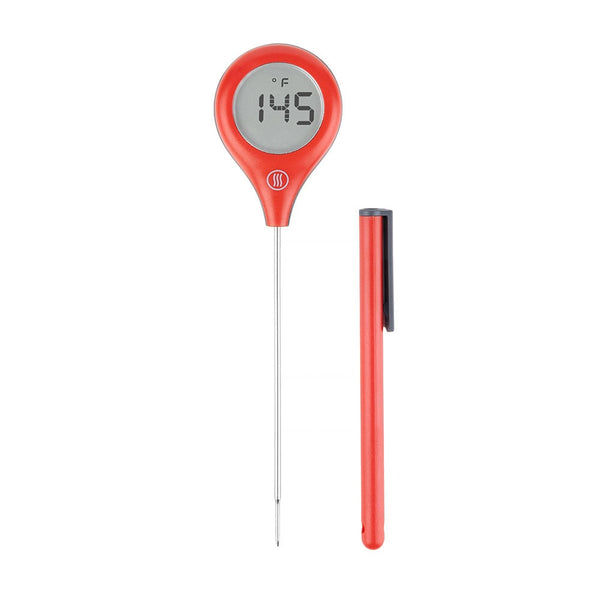
ThermoPop 2 Instant-Read Thermometer
The budget way to stop guessing. Fast, accurate, and easy to read when you are checking a loaf, a cookie, or your dough temperature on a hot day.
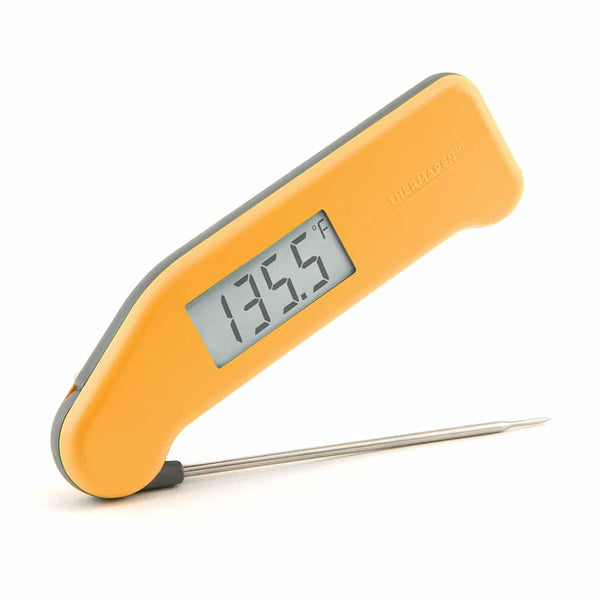
Classic Thermapen Instant-Read Thermometer
The time-tested Thermapen: full readings in 1 to 2 seconds, plus or minus 0.7 degrees F accuracy and a 1500-hour battery. A solid everyday step up from a budget probe, and it ships with a NIST-traceable calibration certificate.
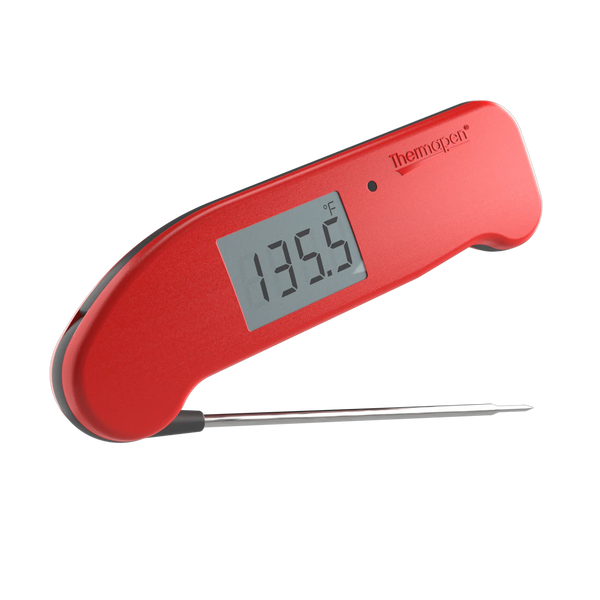
Thermapen ONE Instant-Read Thermometer
Checking internal temp (200-210°F) is the most reliable way to know a loaf is actually done.
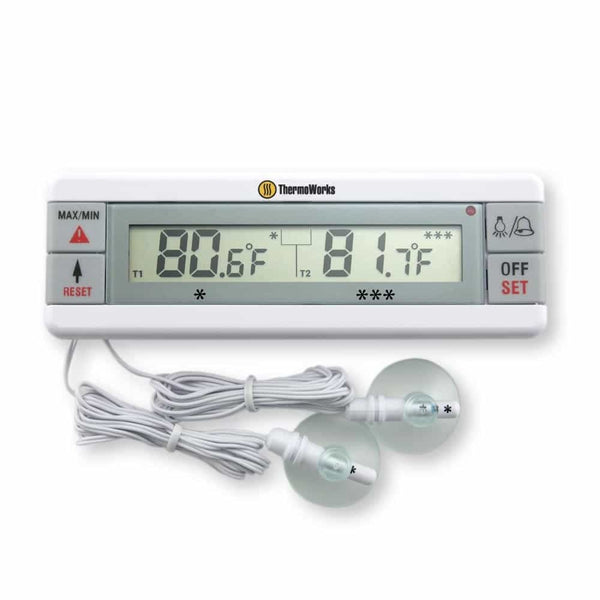
ThermoWorks Fridge/Freezer Thermometer
Two probes, one display: it tracks your fridge and freezer and sounds an alarm if either drifts out of the range you set. Handy for knowing what your fridge is really doing when dough retards overnight.
Cooling Is the Upgrade, Not Warming
Here is the part the northern guides get backwards for us. You do not need a starter warmer in a hot kitchen. Goldie-style warmers hold a starter at the high 70s to low 80s, which is where my kitchen already sits in July. A proofing box set to 78 degrees is a very expensive way to reproduce my counter. What you need is a way to go the other direction, and the options run from free to serious.
The same goes for humidifiers. Do You Need a Humidifier to Proof Sourdough? covers the one case where it helps, a very dry house, and why it rarely matters here.
Start with the free ones. Ice water in the mix drops the dough’s starting temperature by several degrees and buys you an hour of bulk. Running the air conditioning a couple of degrees cooler on bake day is cheaper than any gadget. Your refrigerator is already a retarder: shaping in the afternoon and proofing overnight in the fridge is the single most reliable move in a warm climate, because it hands the timing back to you. The next step up costs almost nothing: a hard-sided cooler with a frozen water bottle or two in the bottom and a rack over them holds the mid-60s for hours and makes a fine bulk-fermentation box on the days you want slower, better flavor without committing the dough to the fridge yet. After that comes a small wine fridge or dorm fridge set to the mid-50s, which is the sweet spot for a long, flavorful bulk and is what I would buy before any proofer. The only proofing box worth considering for us is one that can cool as well as heat, and the standard folding proofer does not. For a starter, Brod and Taylor’s Sourdough Home does, and a dough-sized proofer with a cooling mode is a cottage-bakery purchase, not a first-year one.
The one starter appliance that cools
Holds a jar anywhere from 41 to 122 degrees F, so it can slow a starter in July or warm it in January. It is made for a starter jar, not for dough.
Desi Recommends
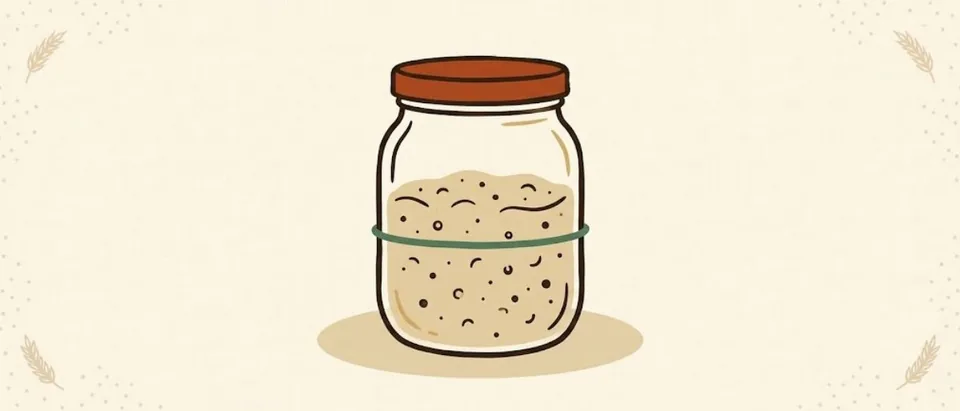
Brod & Taylor Sourdough Home
A starter warmer and cooler that holds a jar anywhere from 41 to 122 degrees F, so you can slow a starter down in a hot kitchen or warm it up in a cold one. Made for a starter jar, not for proofing dough.
| Option | Typical temperature | Cost | Best for |
|---|---|---|---|
| Ice water in the mix | Dough starts 4 to 8 degrees F cooler | Free | Every summer bake |
| Fridge retard (shape, then proof overnight) | 34 to 42 degrees F | Free | Taking the timing back; weeknight schedules |
| Cooler with frozen bottles | Low to mid 60s | Under $40 if you own a cooler | Slower bulk on the hottest days |
| Wine or dorm fridge | 50 to 58 degrees F | $100 to $200 | Long, flavorful bulk; multiple loaves at once |
| Proofer with cooling mode | Set anywhere from the 40s to the 90s | Several hundred dollars | Cottage bakers running several batches a week |
| Starter warmer or heat-only proofer | 75 to 82 degrees F | $100 to $250 | Not us. Skip it unless your kitchen drops below 68 in winter. |
Price ranges are approximate at the time of writing and are given to help you compare tiers, not as quotes; check the retailer for current pricing.
A note on the “hot kitchen” starter habit that goes with all of this: feed with a smaller amount of ripe starter (1:5:5 or 1:10:10 instead of 1:1:1), use cooler water, and keep the jar out of the sunny end of the counter. The full explanation of why your starter behaves differently in Florida heat is here if you want the why.
Starter Jars: Straight Sides, Glass, and a Lid That Breathes
In a fast kitchen you need to be able to read your starter at a glance, because it peaks and falls before you expect it to. That means a straight-sided glass jar you can mark with a rubber band or a strip of tape, not a tapered or decorative crock. Glass also tells you the truth about temperature: it does not insulate the way a thick ceramic crock does, so what you read with the thermometer is what the starter is actually living in. Skip airtight clamp lids in summer. A fast starter builds gas quickly, and a loose lid or a lid set on top without the ring is safer and makes the hooch-and-smell check easier. Two jars, not one, so you can feed into a clean jar and let the dishwasher deal with the crusty one, which in humidity would otherwise grow something within a day.
If you are starting from nothing
The starter kit bundles two bannetons, scrapers, a lame and a dough whisk, but no jar. Add a jar and the thermometer above and you have the whole hot-kitchen basics.
Desi Recommends
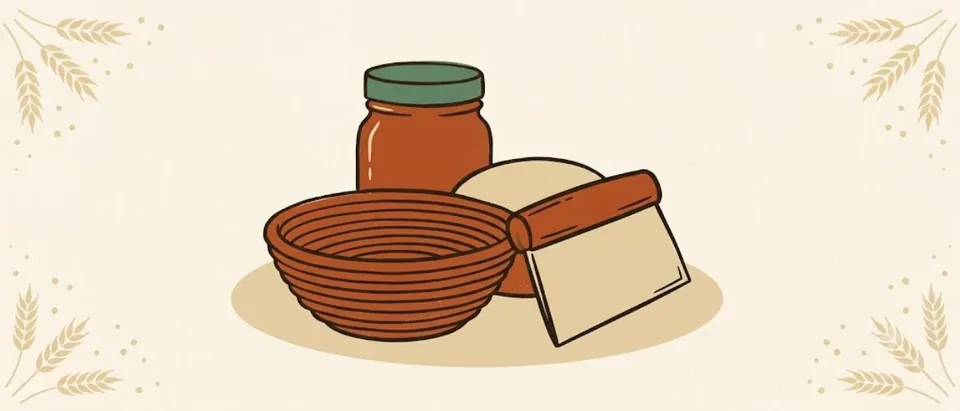
Sourdough Starter Kit Bundle
Two bannetons (9 inch round and 10 inch oval), dough scraper, bowl scraper, lame with 5 blades, dough whisk, brush and linen liners in one box. It has no starter jar, so add one.
Proofing Baskets and the Mold Problem
Bannetons are the piece of equipment humidity is hardest on. Rattan is porous, it comes out of the fridge damp after an overnight proof, and if it goes back on the shelf like that it grows a grey fuzz within the week. The fix is a habit, not a product: brush out the loose flour right after you turn the dough out, leave the basket upside down in the still-warm oven (switched off) or in front of the air conditioning vent until it is bone dry, and never wash it with soap or soak it. A liner helps in two ways in our climate: it keeps a wet, fast-moving dough from gluing itself to the cane, and it is the part you actually launder, so the rattan itself stays dry. If you have already lost one basket to mold, the wood-pulp style bannetons are less porous and dry faster. They are a reasonable swap for the second basket you buy, not a reason to replace the first.
Size matters more here than brand. A 9-inch round holds an 800 to 1,000 gram dough, which is every standard loaf on this site. A 10-inch oval is for batards of the same weight. Buying bigger “to be safe” gives you a wide, flat loaf, and in a hot kitchen a dough that is already inclined to spread does not need the help.
Basket plus liners. The liners are what you wash; the basket should only ever be brushed and dried.
Desi Recommends
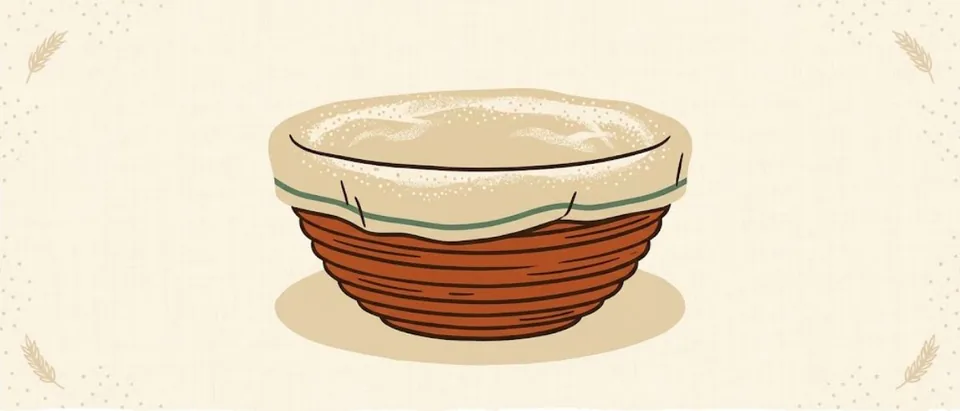
Rattan Proofing Basket (Banneton Set)
- Rattan
Gives your loaf that classic spiral pattern and keeps a wet dough from spreading while it proofs.
Desi Recommends
Banneton Liners, Set of 2
- Set of 2
Slides into a proofing basket to keep dough from sticking. Flour it first. It does not make the basket flour-free, but the loaf releases more easily.
Flour and Salt Storage
An opened paper bag of flour on a Florida pantry shelf is a sponge. Within a couple of weeks it has taken on enough moisture that your 75 percent hydration recipe is behaving like 78, the dough is tackier than it should be, and if you are unlucky you have company: pantry moths and weevils love warm, humid flour. Decant into airtight bins the day you open the bag. Whole grain flours (rye, whole wheat, spelt) and anything fresh-milled go in the freezer, not the pantry. The oils in the bran go rancid fast in heat, and the freezer also ends the pest question. Keep salt in a lidded jar with a few grains of rice or a food-safe desiccant packet, because clumped salt measures unevenly on a scale and you will under-salt a loaf without noticing. None of this requires special equipment beyond a couple of bins, but it is the single most common reason a recipe that “always worked” starts misbehaving in August.
What I keep stocked. Bread flour in a bin, rye in the freezer, salt in a jar with a lid.
Desi Recommends
King Arthur Organic Bread Flour, 5lb (2-Pack)
- 5 lb
- 2-pack
- Organic
A reliable, high-protein bread flour that gives sourdough its structure. Organic and unbleached, sold here as a 2-pack of 5 lb bags.
Desi Recommends
Whole Rye Flour (for feeding starters)
- Whole rye
A spoonful in your feeding routine gives a sluggish starter a real boost of activity.

Desi Recommends
Fine Sea Salt (Baker’s Salt)
Fine grain dissolves evenly into dough, so there are no gritty pockets of salt in your crumb.
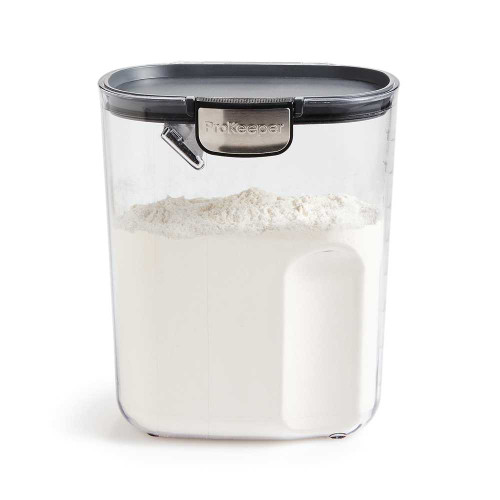
ProKeeper+ Flour Storage Container
An airtight container sized for a bag of flour, with a lid that seals out moisture and pantry pests. Handy when you buy flour in bulk or keep several kinds on hand for your starter.

Baker’s Bread Salt
A fine-grained salt made for dough, so it mixes in evenly and measures consistently by weight. A simple pantry upgrade for bread and pizza dough.
Bake Day: Heat Load, Cast Iron, and Timing
Preheating a Dutch oven to 500 degrees for 45 minutes dumps a lot of heat into a small kitchen, and that heat goes straight into whatever dough is still proofing on the counter. Two habits help: bake first thing in the morning before the house warms up, and do your final proof in the fridge so the dough is not sitting in the warmest room in the house while the oven preheats. Enameled cast iron is the right choice for us over bare cast iron for a boring reason: bare iron rusts between bakes in a humid kitchen unless you oil it every single time, and a combo cooker that lives in a cabinet for a week comes out spotted. Enamel does not care. Whichever you use, lift the loaf out on its parchment the moment it is done rather than letting it sit in the pot. A loaf left in hot cast iron steams its own bottom crust soft, and that crust is already fighting the humidity.
Enamel over bare iron in a humid kitchen
5 to 6 quarts handles every loaf here. See the sizing table in the Equipment Guide before going bigger.

Desi Recommends
6-Qt Enameled Dutch Oven
- 6 qt
- Enameled
I bake in a 5 qt oval and a 6 qt round depending on the loaf. A 6 qt round like this one suits a standard boule, and the tight lid traps steam for a crackly crust.

Cloche Bread Baker With Handle
A domed cloche that traps steam around the loaf for a crisp, blistered crust, like a Dutch oven but easier to lift in and out thanks to its handle. An alternative for bakers who find a hot cast iron pot awkward.

Emile Henry Bread Pot
A glazed ceramic bread pot from Emile Henry that bakes bread under a domed lid so steam stays in and the crust stays crisp. A handsome, heavy-duty option if you want something that goes from oven to table.
Storing the Loaf: Two Days, Not Four
A sourdough loaf in a humid kitchen softens by the second morning and can show mold by the third, and no bread box fixes physics. What works: cool the loaf completely, which takes two hours and not the forty minutes anyone actually waits. Store it cut side down on a board for day one. Move it to a paper bag inside a loose cloth bag for day two, and after that, slice and freeze. Plastic bags trap the moisture the crust is already pulling from the air and are the fastest route to mold. Frozen slices go straight into the toaster and taste better than a three-day-old counter loaf ever will. I wrote up the full set of options in why sourdough goes soft or moldy in humid climates. The short version is that the freezer is the bread box here.
The cloth bag for day two
A linen drawstring bag holds the loaf in its paper bag, so the crust breathes without drying out.

Linen Bread Bag (Drawstring)
A drawstring bag in 100% linen, sewn in Los Angeles. In a humid kitchen it handles day 2 storage: loaf in a paper bag, paper bag in the linen, so the crust breathes without drying out. Several sizes and colors.
Hurricane Season: Starter Insurance
From June through November, assume the power will go out for at least a day at some point. A starter in a warm fridge with no power is fine for 24 hours and usually fine for 48. After that it is a judgment call. The real insurance is a backup: dry a thin layer of active starter on parchment, crumble it into a jar, and keep it in the pantry (it keeps for a year or more), plus a small frozen portion in the freezer door. Both take ten minutes and mean a storm costs you a feeding schedule, not a starter. The walkthrough is in how to dehydrate and rehydrate your starter. If the power is out and the kitchen is climbing toward 85, a cooler with ice packs (the same one from the cooling section above) holds the starter in a safe range for a day with no fuss.
The Short List
| Hot-kitchen problem | What fixes it | Tool or habit |
|---|---|---|
| Bulk finishes hours early | Lower the dough temperature and know what it is | Instant-read thermometer; ice water; cooler with frozen bottles |
| Overproofs overnight in the fridge | Check the fridge is actually cold | Fridge thermometer; move the dough to the back bottom shelf |
| Starter peaks and collapses before you notice | Smaller feeds, cooler water, visible jar | Straight-sided glass jar with a rubber band mark; two jars |
| Banneton molds | Dry it completely every time | Brush, upside down in a warm oven, liners you launder |
| Dough stickier than the recipe says | Keep flour dry | Airtight bins; whole grain flour in the freezer |
| Rust spots on cast iron | Choose enamel or oil after every wash | Enameled Dutch oven |
| Loaf soft or moldy by day two | Stop storing on the counter | Paper plus cloth for a day, then slice and freeze |
| Storm takes the power out | Keep a backup starter | Dried starter in the pantry; frozen portion; cooler with ice packs |
What I Would Not Buy
A starter warmer, for the reasons above. A heat-only proofing box. A ceramic starter crock you cannot see through. An oversized Dutch oven “for when I bake bigger loaves.” A bread box, which in our air is a humidity chamber with a lid. And any gadget that promises to make sourdough faster. Faster is the one thing a Florida kitchen already does for free.
More gear guides
The rest of the equipment series, one decision per guide.
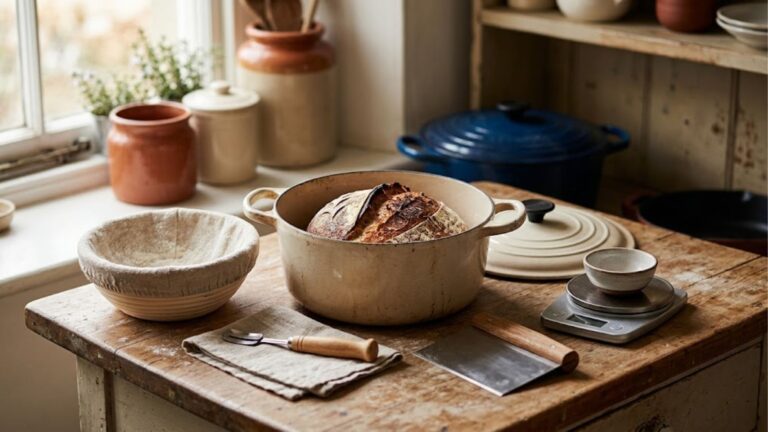
Sourdough Equipment Guide
The full tiered list: what to buy first, what to skip, and the Dutch oven size table.
Read the guide →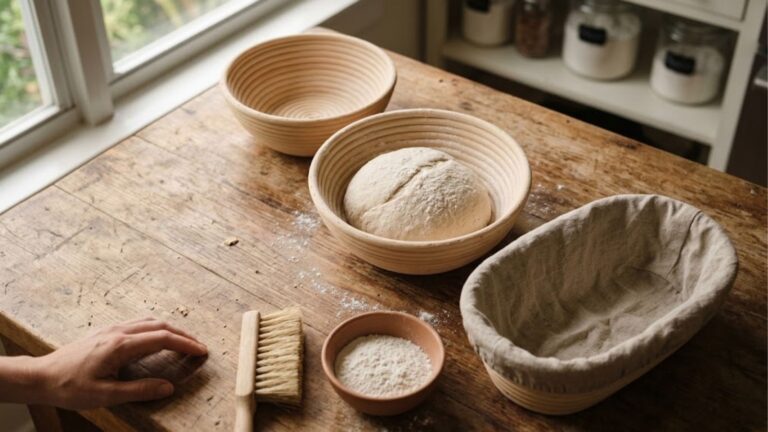
Banneton Sizing and Care
Size chart by dough weight, liners, and keeping mold out in wet air.
Read the guide →
Scoring Tools
UFO vs straight lames, left-handed options, and scoring sticky summer dough.
Read the guide →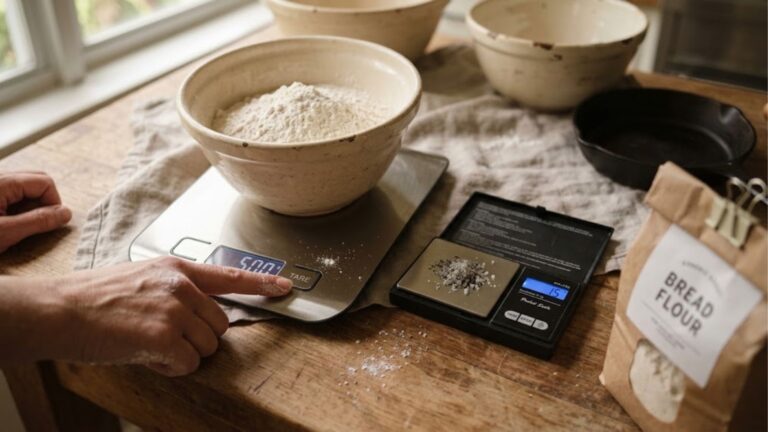
Kitchen Scales for Sourdough
The two-scale setup, the auto-off problem, and legal-for-trade scales for sellers.
Read the guide →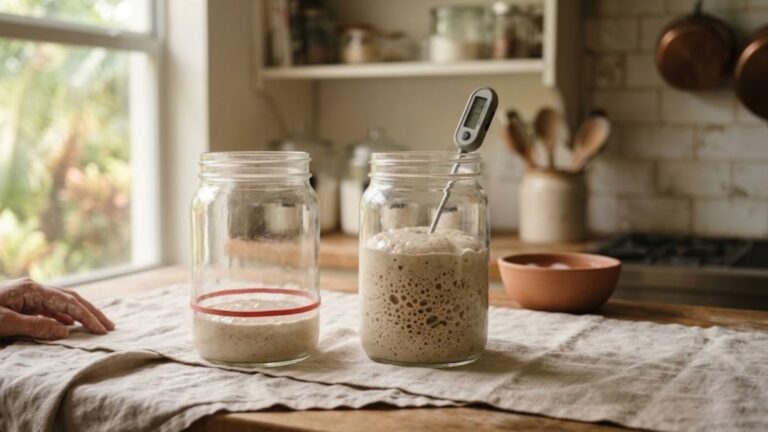
Starter Jars and Climate Control
The right jar, and why a Florida kitchen shops for cooling, not warming.
Read the guide →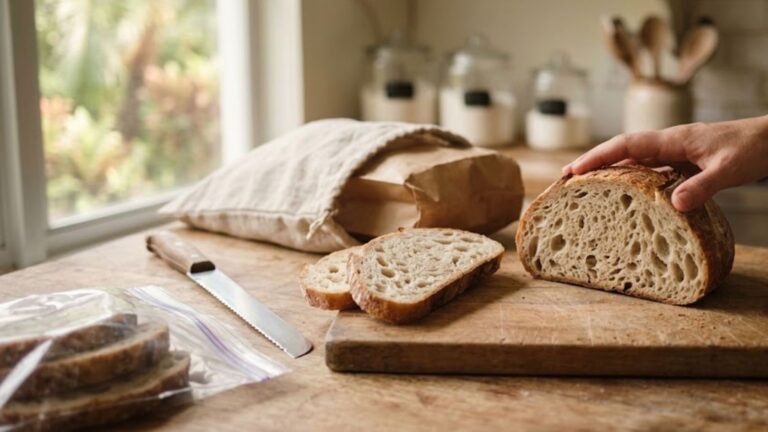
Storing Sourdough in a Humid Climate
Keeping crust and crumb mold-free in wet air, plus the bread knife that does not crush it.
Read the guide →
Pizza Stone vs. Baking Steel
Which one actually belongs in your oven, tested side by side.
Read the guide →Keep Going
For the complete tiered list of tools, including the things that are the same in every climate, see the Sourdough Equipment Guide. If a loaf has already gone wrong, What’s Wrong With My Loaf will diagnose it, and overproofed vs underproofed sourdough covers the mistake we make most often down here. For timing built around a warm kitchen, start with the Florida heat sourdough schedule and let the Sourdough Calculator keep the math honest.