
Banneton Sizing and Care Guide
Which proofing basket fits which loaf, why the wrong size gives you a flat boule, and how to keep rattan from growing fuzz in a humid kitchen. Short version: buy by dough weight, never wash it, and dry it like you mean it.
Some links on this page are affiliate links. As an Amazon Associate I earn from qualifying purchases. If you buy through a link I may earn a small commission at no extra cost to you. Full disclosureA banneton does one job: it holds a soft dough’s shape while it proofs so the loaf goes into the oven tall instead of wide. It is also the piece of equipment people buy wrong most often, usually because the listing says “for 1 to 2 pound loaves” and nobody bakes by the pound. Here is how to pick a size from the dough weight in the recipe, what the material choice actually changes, and the care routine that keeps a basket alive for years in a kitchen where everything else molds.
Size by Dough Weight, Not by Guess
Every recipe on this site lists its total dough weight (flour plus water plus starter plus salt), and that number, not the flour weight and not the finished-loaf weight, is what the basket needs to match. A basket that is too big lets the dough relax outward during the final proof and you get a wide, low loaf no matter how good your shaping was. A basket that is too small means the dough crowns above the rim, sticks to the cloth you covered it with, and tears on the way out. The table below is the one I actually use. The diameter is measured across the top inside edge.
| Total dough weight | Round (boule) | Oval (batard) | Typical recipe |
|---|---|---|---|
| 500 to 700 g | 7 inch round | 8 inch oval | Small or half loaves, mini boules for gifting |
| 750 to 1,000 g | 8.5 to 9 inch round | 10 inch oval | Every standard loaf on this site, including the plain sourdough loaf |
| 1,000 to 1,250 g | 10 inch round | 12 inch oval | Large family loaves, seeded or inclusion-heavy doughs |
| 1,250 to 1,500 g | 11 to 12 inch round | 13 to 14 inch oval | Cottage bakery “big loaf,” needs a 7 quart Dutch oven or open baking |
Two rules of thumb if you are between sizes. For a high-hydration dough (78 percent and up), go down a size. It will spread to fill whatever you give it. For a stiff or heavily seeded dough, go up a size. It holds its own shape and needs the room. And match the basket to your pot: a 9 inch round banneton and a 5 to 6 quart Dutch oven are made for each other, while a 10 inch oval needs an oval cocotte or an open bake on a steel. The Equipment Guide has the Dutch oven sizing table.
Round or Oval?
Buy the shape you bake most, and if that is “I do not know yet,” buy round. A round basket matches the round Dutch oven nearly everyone starts with, boules are the easier shape to learn, and the spiral pattern a round rattan basket leaves on the crust is the one people picture when they think of sourdough. Ovals come later, when you want sandwich-friendly slices or you have an oval pot. Owning one of each is the right end state. Owning three ovals and no round is how a lot of cabinets end up.
A pot made for the loaf
If you bake round loaves, Le Creuset makes a bread oven in the same shape as a round banneton.

Le Creuset Signature Bread Oven, 9.5-Inch Round
Le Creuset's round bread oven, shaped for a single boule. A fit for anyone who bakes a loaf most weeks and wants a pot made for bread.
Rattan, Wood Pulp, or Plastic: What the Material Changes
Traditional cane rattan is the classic for a reason: it is porous, so it wicks a little moisture off the dough surface during the proof and gives you a skin that scores cleanly, and it leaves that spiral. Its weakness is exactly that porosity. It holds water, it dries slowly, and in a humid kitchen it is the thing most likely to mold. Pressed wood pulp baskets (the smooth, grey-brown ones) are denser, dry much faster, and leave a smooth crust rather than rings. They are my recommendation for the second basket you buy here, or the first if you have already lost one to fuzz. Plastic proofing baskets are the professional’s choice for volume because they go in the dishwasher, but they do not wick at all, so you rely entirely on a liner and a good dusting, and the crust is a little softer. For a home baker in a humid climate the practical order is: rattan with a liner first, wood pulp second, plastic only if you are proofing a dozen loaves a week.
Do You Need a Liner?
In a dry climate, a well-seasoned bare basket and a dusting of rice flour is all you need. In a humid one I use a liner most of the time, for three reasons. A wet, fast-moving summer dough glues itself to bare cane far more often than the videos suggest. The liner is the part that actually gets washed, which means the rattan never does. And a liner lets you proof a sticky dough in a basket you only half-remembered to dust. The trade is the spiral pattern. With a liner you get a smooth crust. I keep two liners per basket so one is always dry. Dust the liner itself with a 50/50 mix of rice flour and bread flour. Rice flour does not absorb water and is what keeps things from sticking.
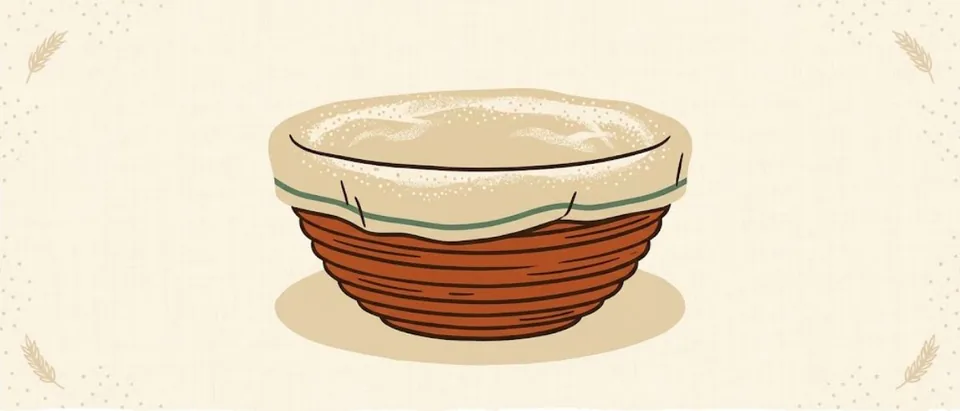
The basket I use for every standard loaf, and the liners that keep it dry. Buy the 9 inch round first.
Desi Recommends
Rattan Proofing Basket (Banneton Set)
- Rattan
Gives your loaf that classic spiral pattern and keeps a wet dough from spreading while it proofs.
Desi Recommends
Banneton Liners, Set of 2
- Set of 2
Slides into a proofing basket to keep dough from sticking. Flour it first. It does not make the basket flour-free, but the loaf releases more easily.
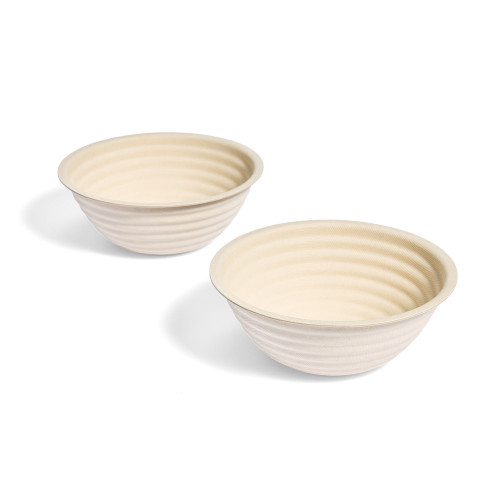
Brod & Taylor Round Bannetons, Set of 2
A pair of round bannetons from King Arthur for proofing boules and rounds. Flour them, set the shaped dough seam-side up, and the spiral rings leave that classic pattern on the crust. A good way to buy two at once.
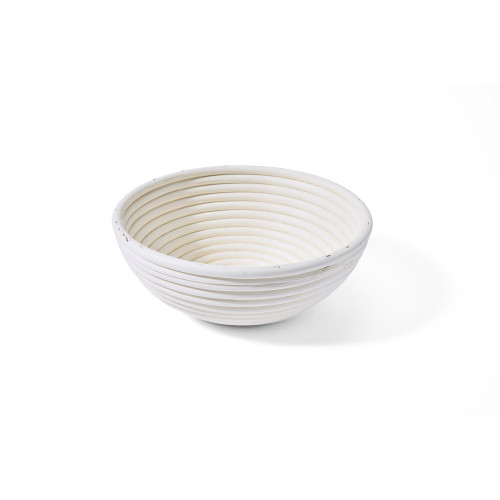
Round Brotform
A traditional round brotform, the proofing basket bakers use to hold a shaped loaf while it does its final rise and to give the loaf a rustic ring pattern. Budget-friendly and all you need for a standard boule.
Seasoning a New Basket
A brand new rattan basket is slick, and the first dough you put in it will stick. Season it before the first bake: mist it very lightly with water, dust it heavily with rice flour, tap out the excess, and let it dry completely. The first two or three loaves will still need a generous dusting. After that the cane develops a light flour skin and releases easily. Never oil a banneton. Oil goes rancid in the cane, it attracts exactly the moisture you are trying to keep out, and it makes the dough stick worse, not better.
The Care Routine That Prevents Mold
Mold on a banneton is almost always a drying problem, not a cleaning problem. The basket comes out of the fridge after an overnight proof cold and slightly damp, it goes back on a shelf in a 78 degree kitchen at 60 percent humidity, and within a week it has grey or white fuzz in the grooves. The routine that stops it takes two minutes. As soon as you turn the dough out, bang the basket face down over the sink and brush out every bit of loose flour with a stiff dry brush. A cheap natural-bristle pastry brush is fine, and that flour is what the mold eats. Then dry it properly: upside down in the oven after you have switched it off and the door has been open a few minutes, or on the counter directly in the path of the air conditioning vent, or outside in the sun on a dry afternoon, until it is bone dry to the touch. Only then does it go back in the cabinet, and it should live somewhere with airflow, not in a sealed tub or a plastic bag. Do not wash it with water or soap, do not put it in the dishwasher, and do not store it with the liner inside.
If it does mold anyway, you can usually save it. Brush out as much as you can, then bake it empty at 250 degrees F for 45 minutes to an hour. The dry heat kills the spores and drives the moisture out of the cane. Brush again once it has cooled. If the fuzz is black or has gone deep into the weave, let that basket go and buy a wood pulp one. A liner that has molded goes in a hot wash with a cup of white vinegar. If it still smells, replace it, they are cheap.
Why Does My Dough Stick?
In order of likelihood: not enough rice flour (plain wheat flour absorbs moisture and turns to glue), a dough that was too slack when it went in because it overproofed in the heat, a brand new unseasoned basket, or a damp basket from the last bake. The humid-kitchen fix for the second one is the same as everywhere else on this site: shape a little earlier than you think, use the fridge for the final proof, and read overproofed vs underproofed sourdough if you are not sure which side you are on. A dough that comes out of the fridge cold and firm almost never sticks. One that proofed on the counter in August almost always does.
What You Can Use Instead
You can bake very good bread without a banneton. A mixing bowl lined with a clean, heavily floured tea towel does the same job for a boule. A loaf pan lined with a towel works for a short batard. A colander lined with a towel breathes better than a bowl. What you cannot skip is the rice flour and the structure: a soft dough left to proof free on a sheet pan will spread. If you are deciding whether to buy a basket at all, bake three loaves in a towel-lined bowl first. If you are still baking after that, the basket pays for itself in convenience and in loaves that do not stick.
More gear guides
The rest of the equipment series, one decision per guide.
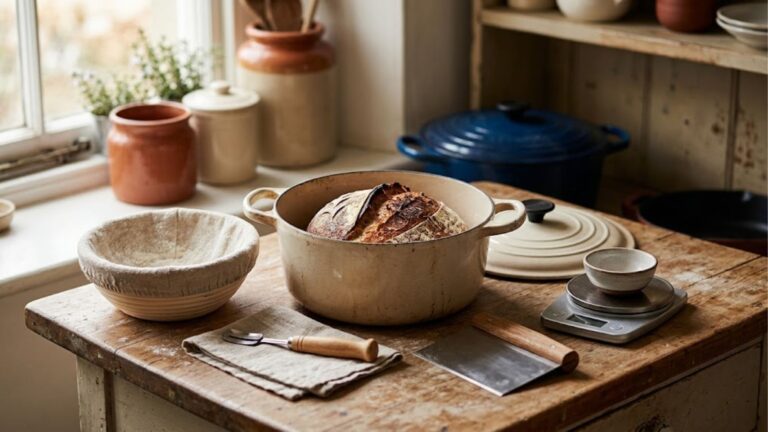
Sourdough Equipment Guide
The full tiered list: what to buy first, what to skip, and the Dutch oven size table.
Read the guide →
Sourdough in a Hot, Humid Kitchen
What changes when your kitchen is 79 degrees, and the gear that actually helps.
Read the guide →
Scoring Tools
UFO vs straight lames, left-handed options, and scoring sticky summer dough.
Read the guide →
Kitchen Scales for Sourdough
The two-scale setup, the auto-off problem, and legal-for-trade scales for sellers.
Read the guide →
Starter Jars and Climate Control
The right jar, and why a Florida kitchen shops for cooling, not warming.
Read the guide →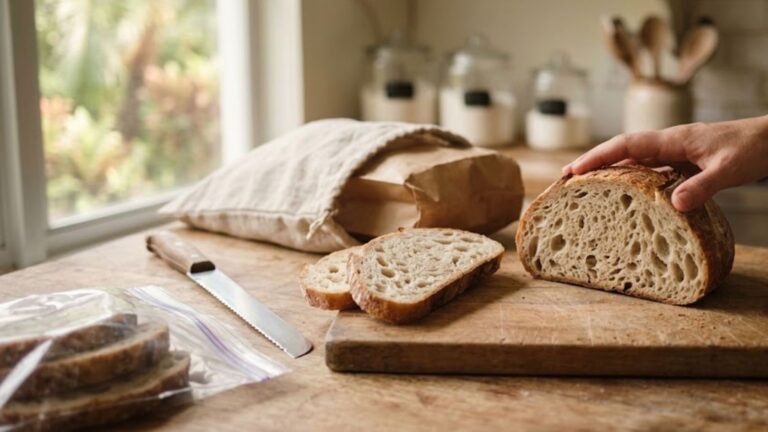
Storing Sourdough in a Humid Climate
Keeping crust and crumb mold-free in wet air, plus the bread knife that does not crush it.
Read the guide →
Pizza Stone vs. Baking Steel
Which one actually belongs in your oven, tested side by side.
Read the guide →Keep Going
Everything else in the humid-kitchen toolkit is in Sourdough in a Hot, Humid Kitchen. For the full tiered list of tools see the Sourdough Equipment Guide, and if a loaf came out of the basket wide and flat, sourdough spreading instead of rising up walks through the causes in order.