
How to Tell When Your Starter Is Ready to Bake With
You fed your starter this morning. Now you are standing at the counter wondering whether it is ready, because your recipe says to use an active starter, and nobody ever says exactly what active looks like.
The good news is that a starter tells you everything you need to know, once you know where to look. You will watch four things: how high it has risen, what the top looks like, how bubbly it is, and how it smells.
The Short Answer
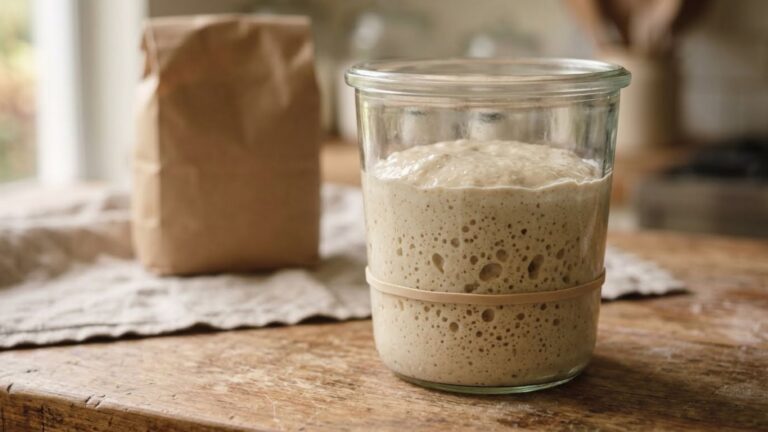
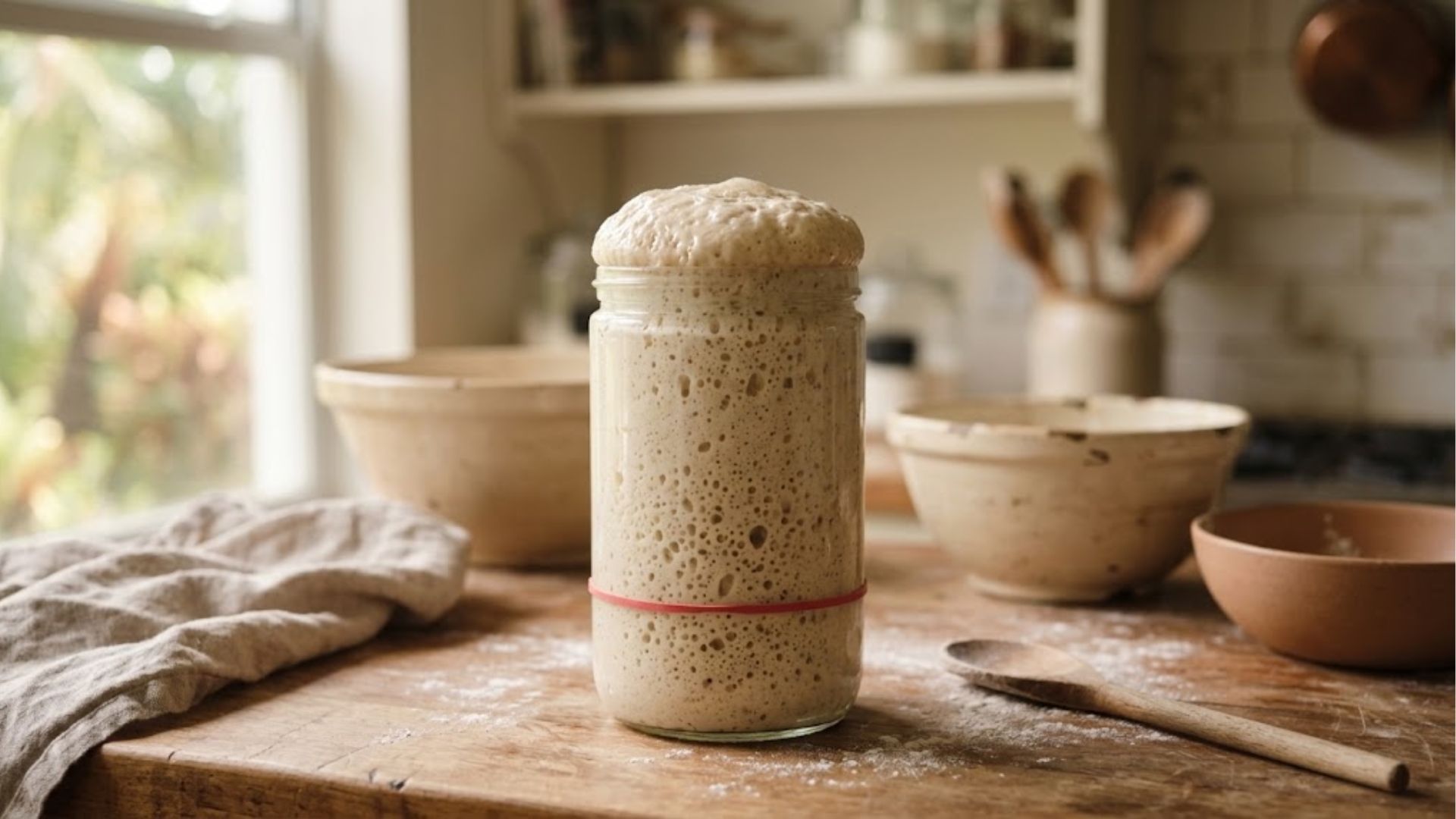
Your starter is ready when it has risen to about double its starting height (often more), has a domed or slightly flattened top, is full of bubbles all the way through, and smells pleasantly sweet and tangy rather than sharp. Use it at its peak or just before it begins to fall. Mark the starting level with a rubber band and note the time, and you will learn your own starter’s rhythm within a couple of feedings.
The Rubber Band Method
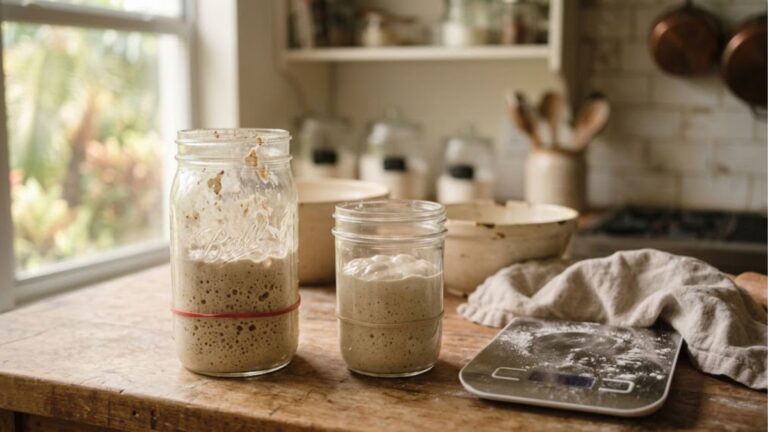
This is the easiest habit to build. After you feed your starter, put a rubber band or a strip of tape around the jar at the level of the starter. Write down the time. Now you have a built-in yardstick.
Check back every hour or so once the starter begins to rise. When it stops climbing and the top looks level or gently domed, you have found the peak. Next time, you will know roughly how many hours that takes after a feeding, and you can plan your baking around it.

What Peak Looks, Feels and Smells Like
- Height: it has at least doubled, and a strong, young starter often triples.
- The top: a domed or slightly flat surface with bubbles breaking through. A rounded dome usually means it is still climbing.
- Bubbles: many small and medium bubbles throughout the starter, visible through the glass, with a few large ones at the top.
- Texture: when you stir it, the starter is light, airy and stretchy, with a web of strands rather than a flat paste.
- Smell: pleasantly sweet and tangy, like yogurt or beer. A sharp nail polish or vinegar smell means it is hungry.
Early, Peak, or Late?
| What you see | What it means | What to do |
| Barely any rise, few bubbles | Not ready yet, or too cool | Wait, or move it somewhere a little warmer |
| Rising with a rounded dome | Almost there, still climbing | Bake with it now if you are in a hurry, or wait an hour for the peak |
| Domed or flat top, risen well, airy | At its peak | Mix your dough now |
| Top sunken, ring of residue on the glass | Past its peak and hungry | Feed it again and use it at the next peak, or use it for something forgiving |
↔ Swipe to see all columns
Using a starter slightly past its peak will not ruin a bake, and it is often fine for a forgiving recipe. But the strongest rise comes from a starter at or just before its peak, so try to aim there when you can.
A Word About the Float Test
You may have heard that you can drop a spoonful of starter into water and call it ready if it floats. It is a popular trick, but it is not a very reliable one. We explain why in Why the Float Test Lies to You. Your eyes, your nose and a rubber band will serve you better.
Desi’s Note
The most useful thing I can suggest is to keep a small log for a week. Write the feeding ratio, the time, and when the starter peaked. By the end of the week you will have a schedule that is personal to your starter and your kitchen, and you will never have to guess again. Our Starter Feeding & Discard Log is a printable way to do it.
Planning Around the Peak
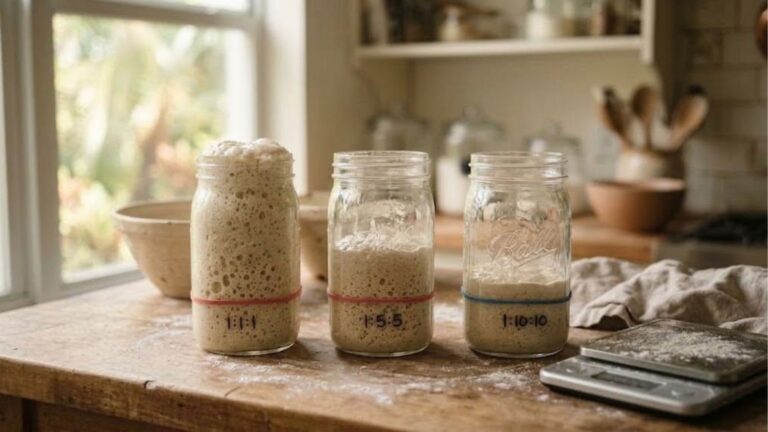
Once you know when your starter peaks, you can time everything else around it. A bigger feeding ratio pushes the peak later, and a warmer spot brings it sooner. Our guide to feeding ratios shows how to shift the timing to fit your day.
Related Reading
- Why the Float Test Lies to You
- Sourdough Starter Problems: Not Rising, Runny, or Smelling Off
- Levain vs. Starter: What Is the Difference?
- Starter Troubleshooting Quicksheet
Watch the jar, not the clock, and your starter will tell you when it is ready.
More Resources
Looking for a printable reference? Browse all six Printable Quicksheets, or dial in your own numbers with the Sourdough Calculator.
Knead to Know?
New recipes and sourdough troubleshooting, delivered before your starter even finishes its next rise.
Get the latest insights with no spam, just new recipes and baking tips. Unsubscribe anytime. See our Privacy Policy.