
Gluten-Free Sourdough Bagels
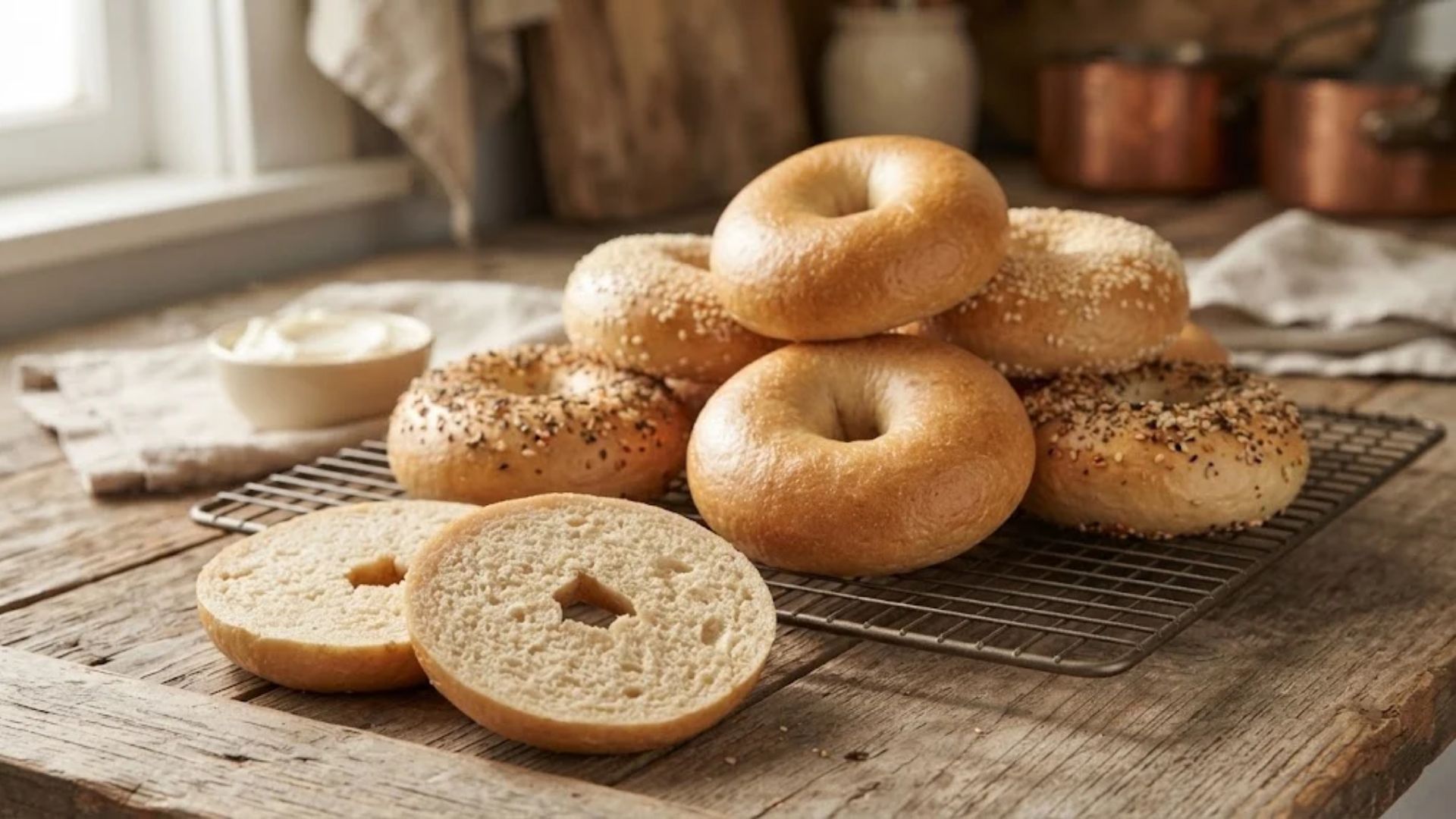
Gluten-free sourdough has a reputation for falling apart, and bagels are usually the first thing people assume is off the table. This recipe uses a psyllium husk gel in place of gluten, which gives the dough enough structure to hold a ring shape through a real boil and a real bake.
Every weight here is in grams. A gluten-free flour blend behaves differently depending on its starch ratio, so a kitchen scale matters more here than it does with wheat flour, where a cup of flour from two different bags is roughly interchangeable.
Which one is this?Compare all 3 bagel recipes
These 3 bagel recipes are close cousins. Here is how they differ, so you can pick the right one.
- Classic Sourdough Bagels22 hr 5 min · Makes 12 bagels
Cane sugar and maple syrup in the dough, with a short two-stage knead before a quick boil.
You want a classic bagel and can bake it the same day or finish it overnight.
- New York-Style Sourdough Bagels15 hr 59 min · Makes 8 bagels
150 g of active starter and malt syrup, an overnight fridge rest, a longer boil and an egg white wash.
You want the malt syrup and longer boil of a New York-style bagel.
- Gluten-Free Sourdough BagelsYou are here4 hr 38 min · Makes 6 bagels
A psyllium gel dough on a gluten-free bread flour blend and a gluten-free starter, boiled in honey and baking soda water.
You bake gluten-free and still want a boiled bagel.
Why You’ll Love It
- A psyllium-gel dough that boils and bakes using the same technique as a wheat bagel, chewy crust included.
- Built on your gluten-free sourdough starter, so the tang comes from real fermentation rather than vinegar or extra yeast.
- Freezes well once baked, so a batch of 6 covers more than one breakfast.
- Mixed in one bowl by hand. No stand mixer required.
- A genuine boiling-water step, the part of bagel-making that most gluten-free versions skip.
Ingredients
Measure the flour blend and the psyllium husk powder by weight. Gluten-free blends pack differently from cup to cup, and a few extra grams of psyllium make the dough noticeably stiffer.
For the Dough
- Gluten-free bread flour blend (420 g (about 3¼ cups)): the base structure, built from a blend of rice, potato and tapioca starches since gluten-free flour cannot develop gluten on its own.
- Psyllium husk powder (14 g (about 1½ tablespoons)): forms a thick gel that acts as this dough’s gluten substitute, holding the bagel shape through boiling and baking.
- Warm water (130 g (about ½ cup plus 1 tablespoon)): blooms the psyllium into a gel.
- Active gluten-free sourdough starter (100 g (about ½ cup)): built from a gluten-free flour, adds tang and the first stage of rise.
- Whole milk, lukewarm (80 g (about ⅓ cup)): adds richness and a touch more hydration.
- Egg (50 g (1 large)): adds structure and protein that gluten-free dough is otherwise short on.
- Honey (25 g (1 tablespoon)): a little sweetness, and it helps the crust brown.
- Olive oil (15 g (1 tablespoon)): keeps the crumb from drying out.
- Fine salt (8 g (1½ teaspoons)): controls fermentation and rounds out the flavor.
For the Boiling Water
- Water (2000 g (about 8 cups)): for the boiling pot.
- Baking soda (15 g (1 tablespoon)): raises the pH of the boiling water, which is what gives a bagel its shiny, chewy crust.
- Honey (20 g (1 tablespoon)): a little sweetness in the boiling water that encourages better browning in the oven.
For the Topping (Optional)
- Egg, beaten with a splash of water, for the wash (50 g (1 large)): optional, for shine and to help toppings stick.
- Everything bagel seasoning or sesame seeds, for topping (15 g (2 tablespoons)): optional.
Equipment
Gear guides: Sourdough Equipment Guide·Kitchen Scales·Banneton Sizing·Scoring Tools·Storing the Loaf·Pizza Stone vs. Baking Steel·Shop All Picks →
- Kitchen scale: weighing the gluten-free flour blend precisely matters even more than with wheat flour, since blends vary by brand.
- Large mixing bowl: for mixing and bulk fermenting the dough.
- Instant-read thermometer: confirms the milk temperature and the bagels’ internal doneness.
- Large pot: for boiling the bagels, needs to hold at least 3 to 4 quarts of water.
- Slotted spoon: for lowering the bagels into the boiling water and lifting them back out.
- Baking sheet and parchment paper: for the second rest and for baking.
- Pastry brush: for brushing on the egg wash before baking.
- Wire rack: for cooling the bagels so steam doesn’t make the bottoms soggy.
Sample Schedule
Day 1
- Bloom the psyllium gel and mix the dough
- Bulk ferment 3 to 4 hours
- Divide, shape and rest 30 minutes
- Boil, top and bake
Gluten-Free Sourdough Bagels
Method
- Whisk the psyllium husk powder into the warm water and let it sit for 5 minutes until it thickens into a gel.
- In a large bowl, whisk the starter into the milk until fully dissolved, then whisk in the psyllium gel, egg, honey and olive oil. Add the flour blend and salt and mix into a thick, sticky dough. There is no kneading since there is no gluten to develop.
- Cover the bowl and let the dough rest at room temperature for 3 to 4 hours, until it looks puffy and slightly aerated.
- Divide the dough into 6 pieces of about 140 g each. With wet hands, roll each into a ball, then poke a hole through the center and stretch it into a bagel shape.
- Cover the shaped bagels loosely and let them rest for 30 minutes.
- Bring the boiling water, baking soda and honey to a rolling boil. Boil each bagel for 60 seconds per side, then lift out with a slotted spoon.
- Place the boiled bagels on a parchment-lined baking sheet, brush with egg wash, add any toppings and bake at 425°F (220°C) for 22 to 25 minutes, until deep golden and 205°F (96°C) inside.
- Cool the bagels on a wire rack for at least 20 minutes before slicing.
Notes
Save This Recipe
Get it emailed to you now, plus new recipes as they go up.
Your email is safe with me. I’ll send this recipe straight over. No spam, ever. You can unsubscribe anytime.
How to Make It
1Bloom the psyllium gel. Whisk the psyllium husk powder into the warm water and let it sit for 5 minutes until it thickens into a gel. The gel should look like a loose, translucent jelly, close to the texture of a thin pudding. This gel is doing the job gluten strands would normally do, so give it the full 5 minutes even if it looks ready sooner.

2Mix the dough. In a large bowl, whisk the starter into the milk until fully dissolved, then whisk in the psyllium gel, egg, honey and olive oil. Add the flour blend and salt and mix into a thick, sticky dough. There is no kneading since there is no gluten to develop. The dough will look more like a heavy, tacky batter than a wheat dough, closer to soft modeling clay than something you could stretch, and that texture is correct for this formula.

3Bulk ferment. Cover the bowl and let the dough rest at room temperature for 3 to 4 hours, until it looks puffy and slightly aerated. A gluten-free starter ferments more slowly than a wheat one and will never double the way a wheat dough does, so judge this bowl by a modest rise and a few visible bubbles at the surface. In a South Florida kitchen running the air conditioning, lean toward the full 4 hours.
4Divide and shape. Divide the dough into 6 pieces of about 140 g each. With wet hands, roll each into a ball, then poke a hole through the center and stretch it into a bagel shape. Keep a small bowl of water next to you and wet your hands between bagels. This dough is softer and stickier than wheat dough, so work quickly. Expect the ring to look a little rustic, which is normal for this formula.

5Rest the shaped rings. Cover the shaped bagels loosely and let them rest for 30 minutes. They will not puff up much. This short rest simply relaxes the dough so the rings hold together better once they hit the boiling water.
6Boil the bagels. Bring the boiling water, baking soda and honey to a rolling boil. Boil each bagel for 60 seconds per side, then lift out with a slotted spoon. The baking soda raises the pH of the water, which is what sets the shiny, slightly chewy skin a bagel needs. The bagels should float almost immediately. If one sinks and stays down, your dough was mixed too wet, worth noting for next time.

7Top and bake. Place the boiled bagels on a parchment-lined baking sheet, brush with egg wash, add any toppings and bake at 425°F (220°C) for 22 to 25 minutes, until deep golden and 205°F (96°C) inside. The crust should sound hollow when you tap the bottom. If the tops are browning faster than the inside is cooking, tent them loosely with foil for the last 5 minutes.

8Cool completely. Cool the bagels on a wire rack for at least 20 minutes before slicing. Gluten-free bakes firm up as they cool, so a bagel that seems a touch soft straight from the oven will hold together much better once it reaches room temperature.
Tips & Troubleshooting
- Bagel sinks and will not float: the dough was mixed too wet. Next time add the flour blend a tablespoon at a time until the dough is tacky but holds its shape when pinched.
- Dough will not hold the ring shape: wet your hands more often and work fast. Gluten-free dough firms up again within a minute or two of standing, so a ring that slumped can be re-wetted and reshaped before it goes into the boiling water.
- Crust is pale even after 25 minutes: check your oven temperature with a separate oven thermometer. A true 425°F (220°C) matters more here than with a forgiving wheat dough.
- Interior still gummy when cooled: pull the next batch when the center reads a full 205°F (96°C). Gluten-free crumb firms up more as it cools than wheat crumb does, so slice only after the full 20 minutes of cooling.
How to Store
To store: Keep cooled bagels in a sealed bag or container at room temperature for up to 2 days, or in the refrigerator for up to 5 days, since gluten-free bakes dry out fast at room temperature in a humid kitchen.
To freeze: Slice before freezing and freeze in a single layer, then transfer to a bag once solid. Toast straight from frozen. They keep well for about 2 months.
Nutrition
Nutrition is estimated per bagel and will vary with the exact gluten-free flour blend and toppings you use.
245
Calories
44g
Carbs
7g
Protein
6g
Fat
3g
Fiber
430mg
Sodium
Desi’s Notes
Gluten-free sourdough starters vary more than wheat ones depending on the flour blend you feed them, so your bulk ferment time might run shorter or longer than the range given here. Judge the dough by the bubbles and the modest rise, not the clock.
I suspect the psyllium gel step is the one most gluten-free bakers skip, and it is the one that matters most. A thin, underdeveloped gel means a dough that cannot hold a boil.
Before You Bake
Scaling this recipe up or down? Run your numbers through the Sourdough Calculator. And if you want a printable reference for troubleshooting or timing, browse all six Printable Quicksheets.
New to sourdough? Start with the free course
Seven short lessons over 12 days, from mixing your first starter to baking your first loaf with it. Stop anytime.
One short lesson every couple of days. Seven in all, then you’re done. No spam. See our Privacy Policy.
Already have a starter? Bake your first loaf → · Already baking? Browse recipes →
Tried this recipe? Leave a star rating below. It takes 10 seconds and helps other bakers decide what to make next.
Baked this recipe your way? Share it in Community Bakes and inspire other readers.