
Sourdough for Night Shift and Rotating Schedules: Flip the Clock, Keep the Bread
Nearly every sourdough schedule on the internet assumes that you wake up in the morning and go to bed at night. If you work nights, rotate shifts, or keep any other unusual hours, those schedules can feel like they were written for someone else.
The good news is that dough does not know what time it is. Fermentation follows hours, not the clock on your wall, so a schedule can slide to any part of the day. All you have to do is decide which of your waking hours becomes mixing time, which becomes shaping time, and which becomes bake time.
The Short Answer
Pick a point in your day to be your “morning,” meaning the time you wake up, and run the usual schedule from there. For a night worker that might mean feeding your starter when you get home, mixing when you wake in the afternoon, shaping before you leave for work, letting the dough rest in the fridge while you are at work, and baking when you get home. Because a fridge proof is forgiving, you can bake any time within roughly 8 to 16 hours after shaping, which fits almost any shift pattern.
Think in Hours, Not Clock Time
Start by writing down your own day as a series of windows. When are you home and awake? When do you leave? When do you return? When do you sleep? These windows are the only real constraints.
Then lay a standard dough over those windows. A typical sourdough needs about 10 to 15 minutes at mixing, a few two-minute folds spread over three to four hours, about 15 minutes at shaping, and about 10 minutes at baking. Everything else is waiting, and waiting does not need you.
An Example Night-Shift Day
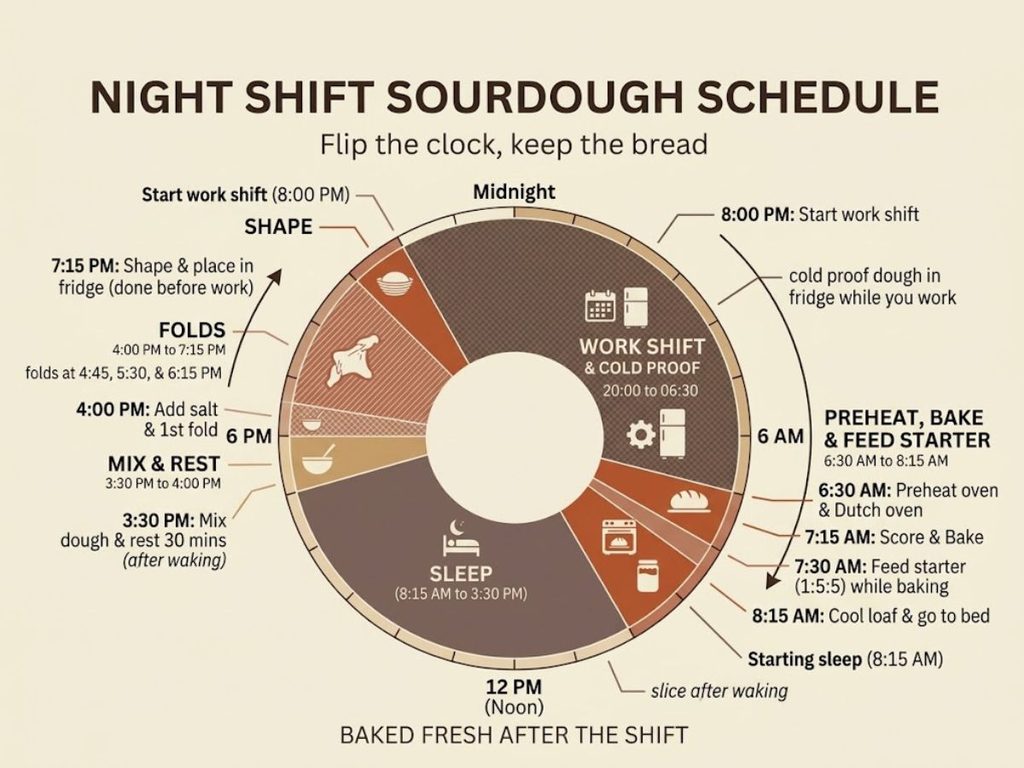
Here is one example for someone who works from 8 pm to 6 am and sleeps from about 8:30 in the morning until mid-afternoon. Treat it as a pattern, not a prescription, and slide the times to match your own.
| When | What to do | Why |
| 6:30 am (home from work) | Preheat the oven and Dutch oven | About 45 minutes; the dough comes straight from the fridge |
| 7:15 am | Score and bake | Covered for about 30 minutes, uncovered for about 15 more |
| 7:30 am | While the loaf bakes, feed your starter 1:5:5 | It will ripen in roughly 8 hours, around when you wake |
| 8:15 am | Cool the loaf, then go to bed | Slice after you wake up |
| 3:30 pm (after waking) | Mix the dough and rest 30 minutes | Your starter or levain should be ripe now |
| 4:00 pm | Add salt and do the first fold | Then folds at about 4:45, 5:30 and 6:15 pm |
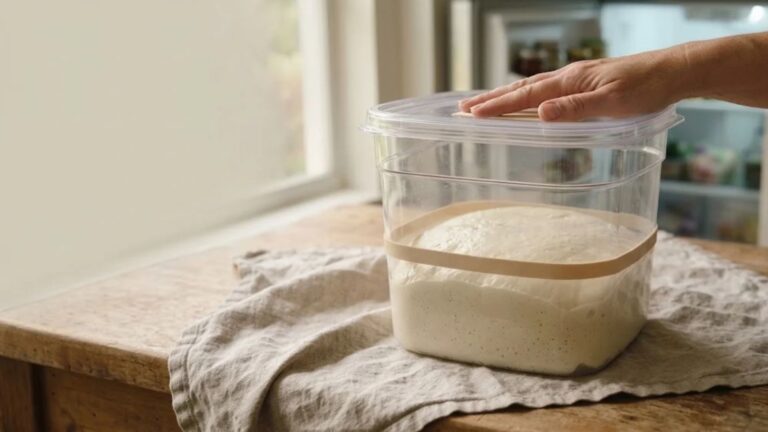
| 7:15 pm | Shape and place in the fridge | Done before you leave for work |
↔ Swipe to see all columns
Rotating Shifts and Changing Weeks
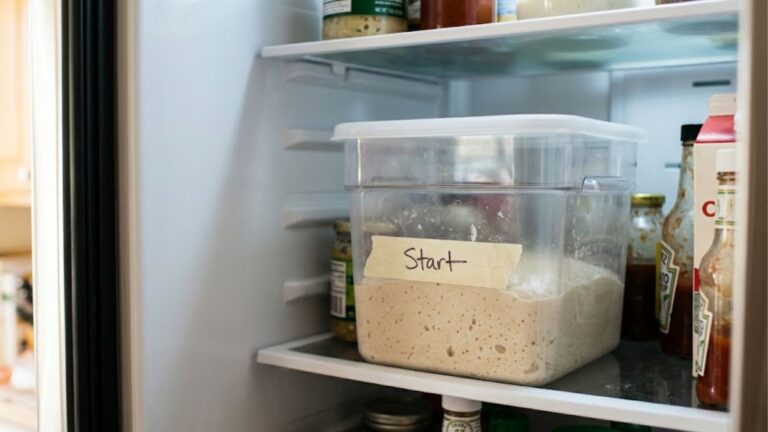
If your shifts change from week to week, keep your starter on the schedule that is easiest and build the dough around it. The simplest approach is to keep the starter in the fridge and take out what you need on the days you plan to bake.
- Fridge starter: keep your starter refrigerated and feed it weekly. On bake days, take it out and feed it at a bigger ratio so it is ripe when you are ready.
- Cold bulk: when your days shift, use our cold-bulk schedule so you can mix at one time and shape at another.
- One bake per rotation: it is perfectly fine to bake just once a week, on the day that fits best.
Sleep and Safety
A word of common sense: never let baking cost you sleep. A forgiving schedule exists precisely so that you can rest. Use timers, lay out your tools before you go to bed, and remember that dough that waits a little longer in the fridge is usually fine.
Desi’s Note
If your life runs on an unusual clock, borrow the fridge. It is the one tool that turns a rigid recipe into a flexible plan. Between a cold proof and a cold bulk, you can fit bread into almost any week.
Adapting the Timing
- Warm home: shorten the warm stages and chill the dough earlier. Our Florida schedule guide covers heat.
- Starter ripe too early or too late: change the feeding ratio. A bigger ratio peaks later, and a smaller one peaks sooner. See Sourdough Starter Feeding Ratios Explained.
- Dough over-proofed after a long shift: try a shorter warm bulk, or less levain, next time.
Common Questions
Is it safe to leave dough in the fridge for that long? Yes. The cold slows fermentation, and dough routinely rests in the fridge for 8 to 16 hours or more.
What if I come home later than planned? A loaf that stays in the fridge a few extra hours is usually fine. If you are going to be much later, bake it when you can rather than letting it go past about 16 hours.
Do I need to feed my starter during the day? Only on bake days, if you keep it in the fridge. See How to Maintain (and Revive) Your Starter.
Related Reading
- The 9-to-5 Sourdough Schedule
- The Cold-Bulk Schedule
- Which Sourdough Schedule Fits Your Life?
- Bake-Day Timeline Template
Dough follows hours, not clocks, so bake on the schedule your life actually keeps.
More Resources
Looking for a printable reference? Browse all six Printable Quicksheets, or dial in your own numbers with the Sourdough Calculator.
Knead to Know?
New recipes and sourdough troubleshooting, delivered before your starter even finishes its next rise.
Get the latest insights with no spam, just new recipes and baking tips. Unsubscribe anytime. See our Privacy Policy.