Plan Backwards: How to Time Your Sourdough So It Is Ready When You Are
Most recipes tell you what to do first, second and third, and leave you to discover that the bread will be ready at 9:45 pm when dinner is at 6:30. That is how a dinner party turns into a late-night snack.
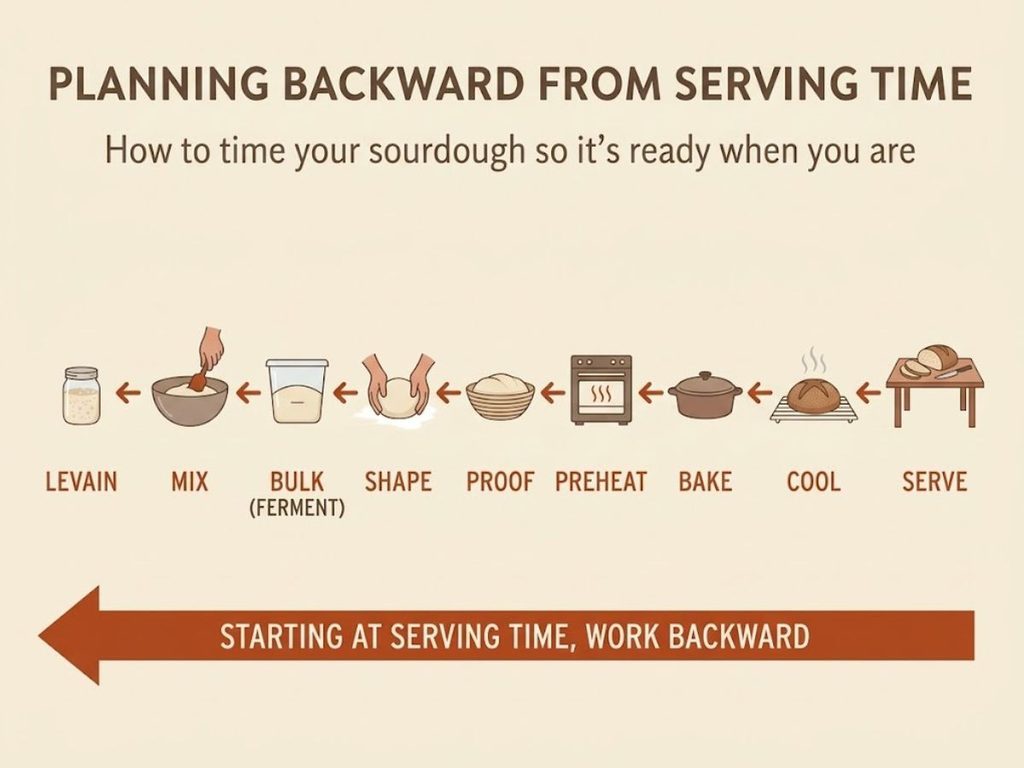
There is an easier way to schedule bread: start at the end. Decide when you want to slice the loaf, and work backward step by step until you reach the moment you need to start. It takes a few minutes of arithmetic and saves a lot of stress.
The Short Answer
Pick your serving time and subtract each stage in reverse: cooling (about an hour), baking (about 45 minutes), preheating (about 45 minutes, overlapping the last part of the proof), final proof, shaping and bench rest, bulk fermentation, mixing and the autolyse rest, and finally the levain build. The total usually lands between 10 and 20 hours before you want to eat, depending on your kitchen and your method. Write the times in a table, and you will know exactly when to start.
The Backward Method
Think of the loaf’s life as a chain. Each link has a typical length, and you simply walk back through the chain from the end.
| Stage (working backward) | Typical length | Notes |
| Slice and serve | n/a | Your target time |
| Cool on a rack | About 1 hour or more | Do not slice hot bread; the crumb is still setting |
| Bake | About 45 minutes | Covered, then uncovered |
| Preheat the oven and Dutch oven | About 45 to 60 minutes | Begins while the dough finishes proofing |
| Final proof | 1 to 2 hours on the counter, or 8 to 14 hours in the fridge | Longer if cold |
| Shape (and bench rest) | About 30 to 45 minutes | Includes a short rest before shaping |
| Bulk fermentation | About 4 to 6 hours in a warm kitchen | Depends on temperature and levain |
| Mix and autolyse | About 30 to 60 minutes | Combine flour, water and levain first |
| Levain build | 4 to 12 hours | Depends on the ratio and kitchen temperature |
↔ Swipe to see all columns
A Worked Example
Say you want to slice bread at 6:30 pm on Saturday, and you will use a same-day method with a counter proof. Work backward:
- 6:30 pm: slice and serve.
- 5:15 pm: the loaf comes out of the oven and cools for about 75 minutes.
- 4:30 pm: the loaf goes into the oven for roughly 45 minutes.
- 3:45 pm: begin preheating the oven and Dutch oven.
- 2:30 pm: the loaf goes into the banneton to proof for about 2 hours.
- 2:00 pm: shape the dough, after a short bench rest starting around 1:30 pm.
- 9:30 am: mix the dough, because a bulk of about four hours takes you to 1:30 pm.
- 9:00 am: your levain should be ripe. For a same-day build at 1:1:1, that means feeding it at about 4:00 am, or for a 1:5:5 build, about 9:00 pm the night before.
Make Your Own Timeline
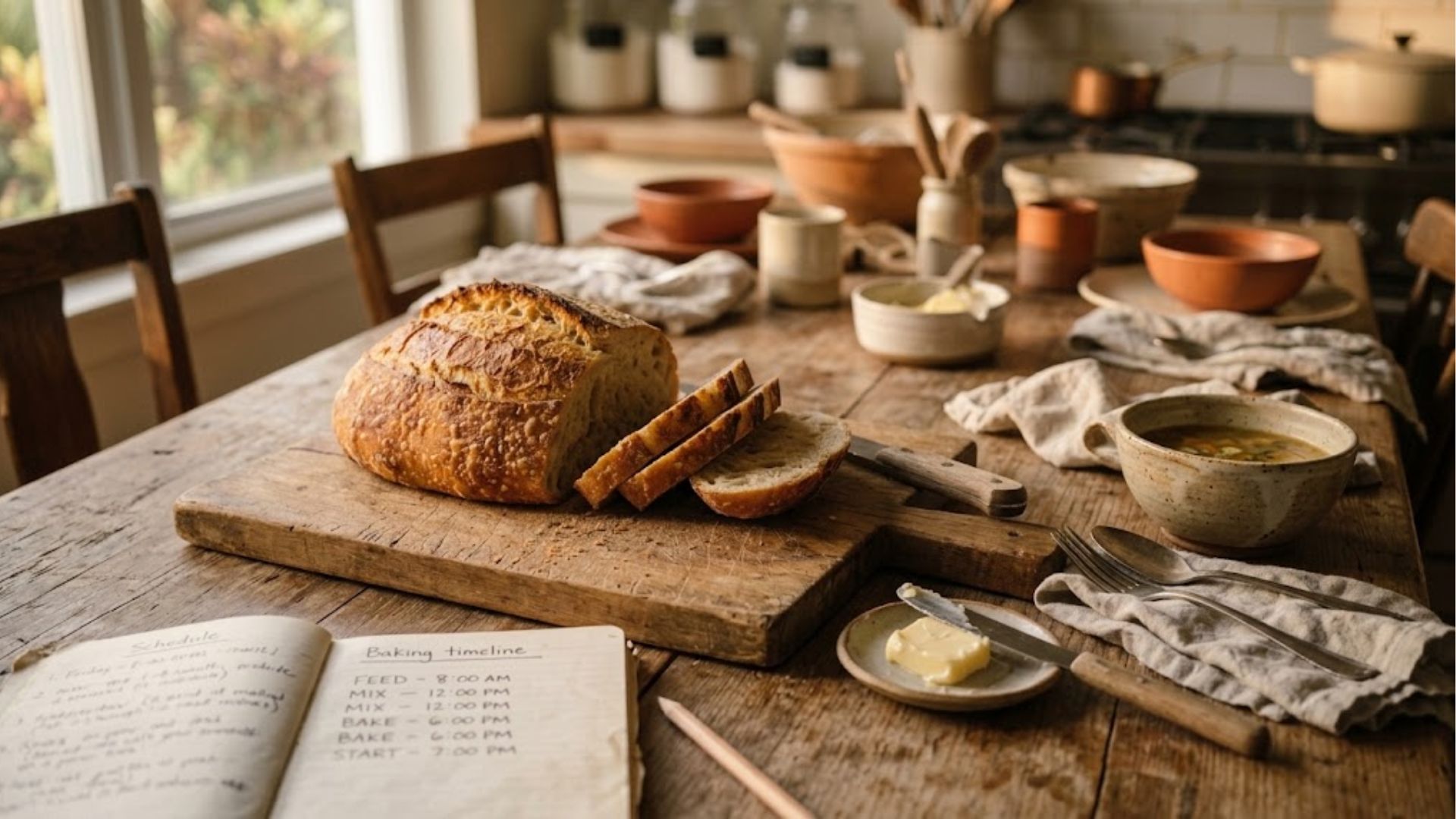
To plan your own, write your serving time on a sheet of paper and fill in the rest. You will need three numbers that depend on your kitchen: how long your bulk usually takes, how long your levain takes to peak, and which kind of proof you are using. Everything else is close to constant.
The Bake-Day Timeline Template gives you a printable form. If you would rather not do the math, the Bake-Day Timeline tab inside the Sourdough Calculator calculates it for you from your bake time and kitchen temperature.
Build In a Buffer
Dough does not respect appointments, so leave breathing room. Add 30 to 60 minutes of slack before your serving time. If the bread finishes early, it simply rests on the rack. If it finishes late, you have time to spare.
Desi’s Note
Always plan to have the loaf out of the oven at least an hour before you need it. It is the one stage you cannot rush, because a loaf that is cut too early has a gummy crumb, and the last thing you want on a special day is a loaf that looks perfect and slices badly.
When Plans Change
- Running late: move the shaped loaf to the fridge to pause the proof for a few hours.
- Running early: move the dough somewhere cool, or bake and enjoy the bread warm in a day or two.
- Warm kitchen: every stage runs faster. See How Florida Heat Compresses Your Schedule.
Related Reading
- Which Sourdough Schedule Fits Your Life?
- The Weekend Sourdough Schedule
- Levain vs. Starter
- The Cold-Bulk Schedule
Start with the table, end with the loaf, and let the arithmetic do the worrying.
More Resources
Looking for a printable reference? Browse all six Printable Quicksheets, or dial in your own numbers with the Sourdough Calculator.
A weekly plan for two loaves is The Two-Loaves-a-Week Sourdough Meal-Prep Bake Day.
Baking for Thanksgiving or Christmas is covered in The Holiday Sourdough Schedule.
Knead to Know?
New recipes and sourdough troubleshooting, delivered before your starter even finishes its next rise.
Get the latest insights with no spam, just new recipes and baking tips. Unsubscribe anytime. See our Privacy Policy.