Sourdough Challah
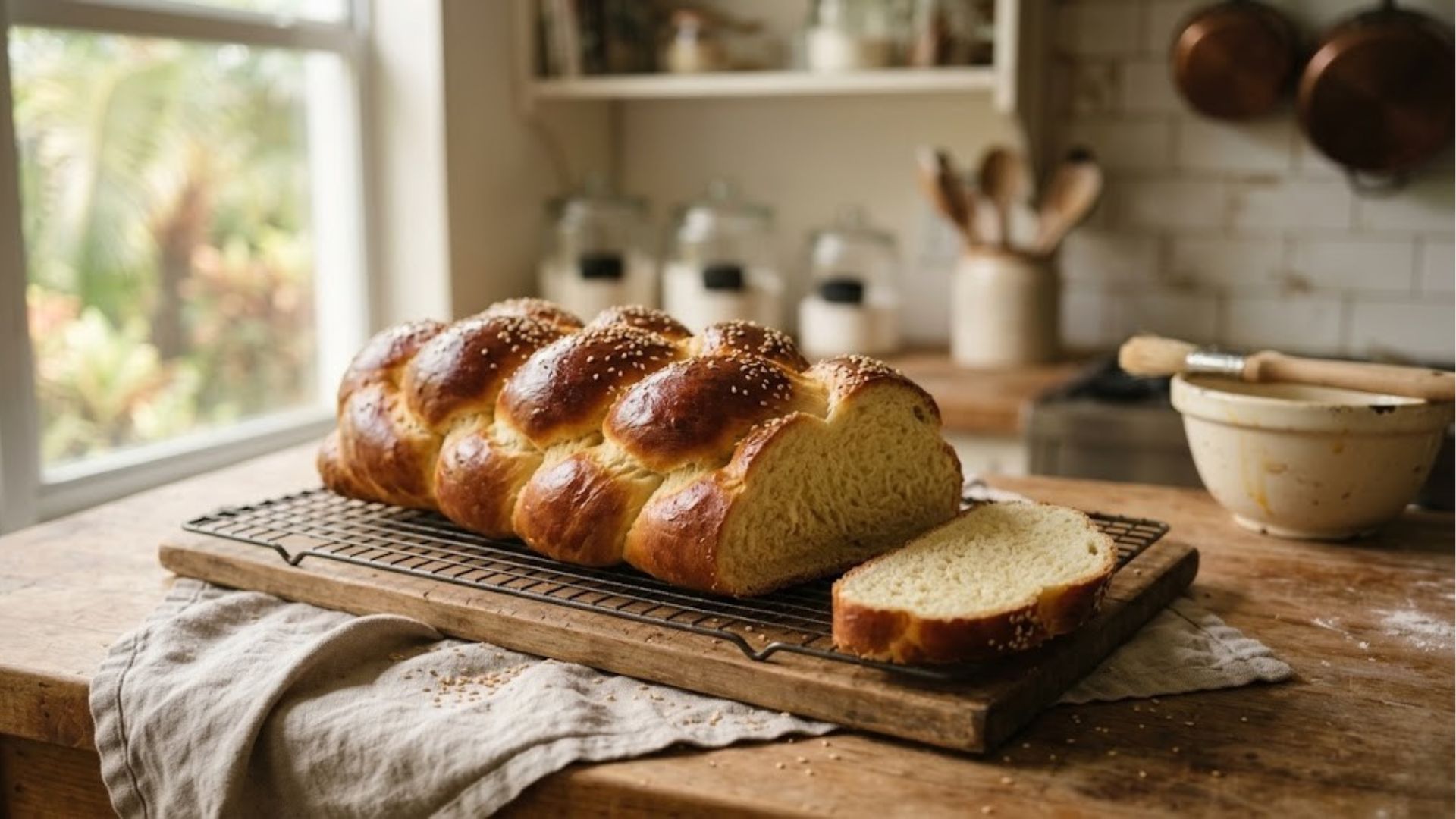
Challah is a traditional braided egg bread, long associated with Shabbat and Jewish holidays, with a soft, slightly sweet crumb and a glossy, golden crust. Making it with sourdough gives it a gentle tang and a lovely, tender texture.
This version is made with oil instead of butter, which keeps it dairy-free, and a simple three-strand braid. Enriched doughs like this one are slow to rise, so give it time and a warm spot. The times on the card follow the same-day route; if you chill the dough overnight instead, add about 5 hours.
Which one is this?Compare both braided bread recipes
Both braided bread recipes are close cousins. Here is how they differ, so you can pick the right one.
- Six-Strand Braided Loaf8 hr 25 min · Makes 12 slices
Bread flour dough with olive oil and honey, braided from six strands.
You want a tall loaf and want to learn the six-strand braid.
- ChallahYou are here10 hr 45 min · Makes 12 slices
Whole egg and yolk plus oil and honey in the dough, with no butter.
You want a traditional soft egg bread.
Why You’ll Love It
- Soft, tender and lightly sweet, with a beautiful glossy crust
- Naturally leavened, with no commercial yeast
- A simple three-strand braid that looks impressive but is easy to learn
- Made with oil, so it is dairy-free
- Fits an overnight schedule: mix one evening, bake the next day
Ingredients
Volume measurements are included for convenience, but they’re approximate. A kitchen scale will always get you a more consistent batch, especially for the flour.
An enriched dough with eggs, honey and oil rises more slowly than a lean dough, so expect a long, patient rise. The dough will feel firm and smooth rather than sticky.
- Bread flour (500 g / about 4 cups): Its higher protein holds up the rich dough.
- Active sourdough starter (100 g / about ½ cup): Fed 4 to 6 hours earlier and at its peak.
- Eggs (100 g / 2 large): Give the dough richness and a golden crumb.
- Egg yolk (18 g / 1 large): Adds extra richness and color.
- Lukewarm water (125 g / about ½ cup): Brings the dough together.
- Honey (70 g / about 3 tbsp): Gives challah its subtle sweetness.
- Neutral oil (60 g / ¼ cup): Keeps the crumb tender. Use a neutral oil such as canola.
- Fine salt (9 g / 1½ tsp): Adds flavor and strengthens the dough.
- Egg for the wash (50 g / 1 large): Brushed on twice for a deep, glossy shine.
- Seeds (5 g / 1 tsp): Optional, sprinkled on top before baking.
Equipment
Gear guides: Sourdough Equipment Guide·Kitchen Scales·Banneton Sizing·Scoring Tools·Storing the Loaf·Pizza Stone vs. Baking Steel·Shop All Picks →
- Stand mixer with a dough hook (optional): makes kneading this firm dough easier, though it can be kneaded by hand.
- Bench scraper: for dividing the dough into even strands.
- Baking sheet and parchment: to proof and bake the braid.
- Instant-read thermometer: to check that the center reaches 190°F (88°C).
- Pastry brush: for the egg wash, brushed on twice for a deeper shine.
- Large mixing bowl: for mixing the dough and for the long, warm rise.
Sample Schedule
Day 1
- Mix and knead the dough
- Bulk ferment at room temperature for 6 to 8 hours, or refrigerate overnight
- Shape the strands and braid
Day 2
- Proof the braid for 2 to 3 hours until puffy
- Brush with egg wash twice
- Bake 30 to 35 minutes at 350°F
Sourdough Challah
Method
- Whisk the starter into the water, eggs, yolk, honey and oil until fully dissolved, then add the flour and mix. Add the salt. Knead 8 to 10 minutes by machine or 12 to 15 by hand, until smooth and elastic.
- Bulk ferment in an oiled, covered bowl at about 78°F (26°C) for 6 to 8 hours until 50 to 75 percent bigger, or refrigerate 10 to 12 hours and rest 1 hour at room temperature.
- Divide into 3 pieces of about 325 g each, shape into balls, and rest 15 minutes.
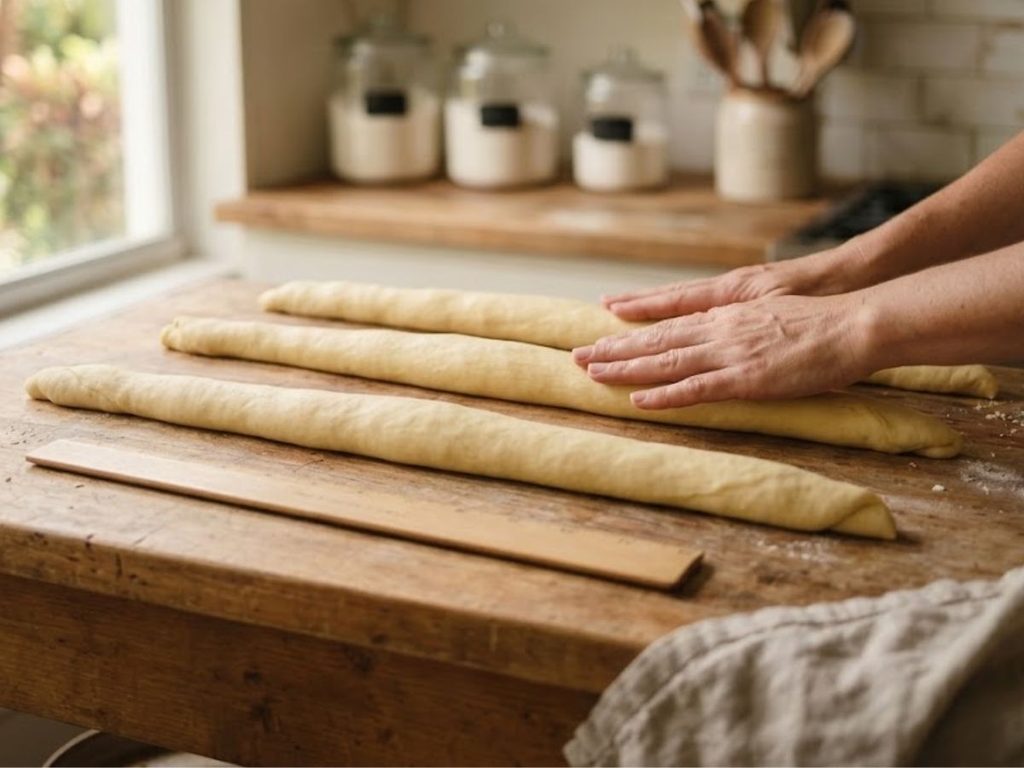
- Roll each ball into a 16-inch rope, thicker in the center and tapered at the ends.
- Pinch the ropes together at the top and braid, keeping the braid snug but not stretched. Pinch the bottom and tuck both ends under.
- Proof on a parchment-lined sheet for 2 to 3 hours until puffy and a gentle finger press springs back slowly.
- Preheat to 350°F (175°C). Brush with egg wash, wait 10 minutes, and brush again. Add seeds and bake 30 to 35 minutes until the center reads 190°F (88°C). Cool 1 hour.
Notes
Save This Recipe
Get it emailed to you now, plus new recipes as they go up.
Your email is safe with me. I’ll send this recipe straight over. No spam, ever. You can unsubscribe anytime.
How to Make It
1Mix and knead. In a bowl or stand mixer, whisk the 100 g of starter into the water, eggs, egg yolk, honey and oil until the starter is fully dissolved. Add the 500 g of flour and mix until a shaggy dough forms, then add the salt. Knead for 8 to 10 minutes by machine on speed 2, or 12 to 15 minutes by hand, until the dough is smooth and elastic. It will be firm but not stiff. A small piece should stretch thin enough to see light through before it tears.

2Bulk ferment. Place the dough in an oiled bowl, cover, and let it rise in a warm spot, about 78°F (26°C), for 6 to 8 hours, until it has grown about 50 to 75 percent. A South Florida kitchen with the air conditioning running is often cooler than that, so a closed oven with only the light on can help. Watch the dough more than the clock. It should look puffy, with a few bubbles at the edges. For an overnight option, refrigerate the dough for 10 to 12 hours, then let it sit at room temperature for 1 hour before shaping.

3Divide into strands. Turn the dough onto a lightly oiled counter and divide it into 3 equal pieces, about 325 g each. Use a scale so the strands match. Shape each into a ball, cover, and rest for 15 minutes so the gluten relaxes and the dough rolls out easily.

4Roll the ropes. Roll each ball into a rope about 16 inches long, working from the center outward with flat hands, so the rope is thicker in the center and slightly tapered at the ends. If the dough springs back, rest it for a few minutes and keep rolling. Keep all three ropes the same length so the braid comes out even.
5Braid the loaf. Line up the three ropes side by side and pinch them together at the top. Braid by bringing the right rope over the middle one, then the left over the new middle, and continue until you reach the end. Keep the braid snug but not stretched, because a braid pulled too tight can tear as it rises. Pinch the bottom and tuck both ends under the loaf.
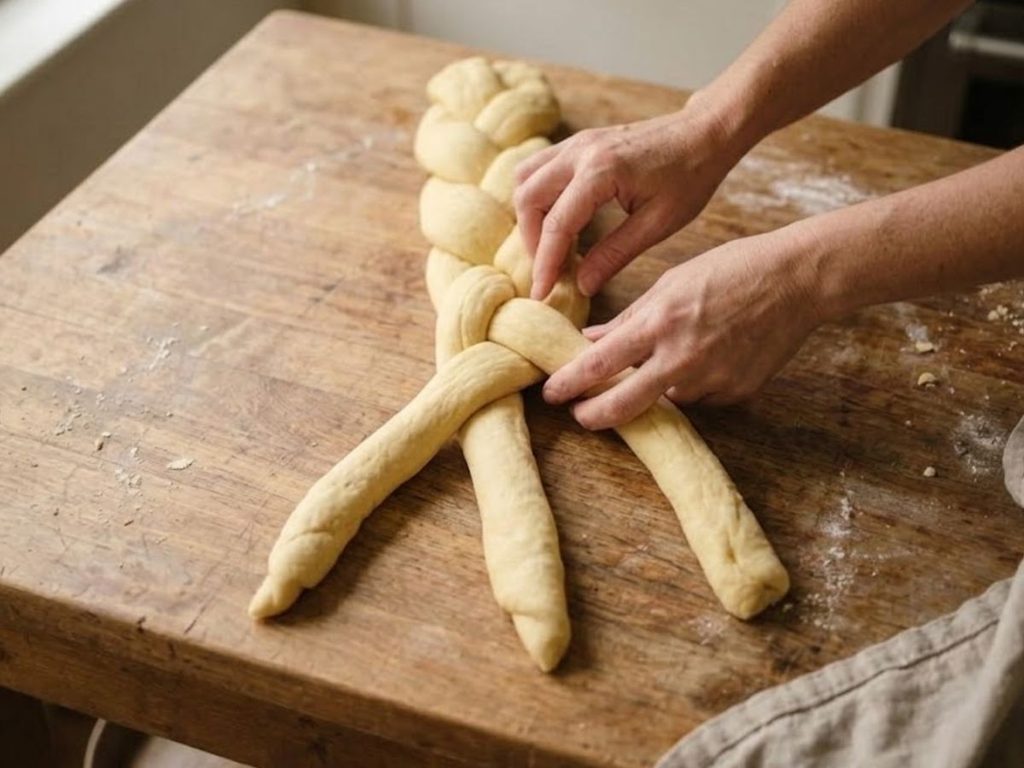
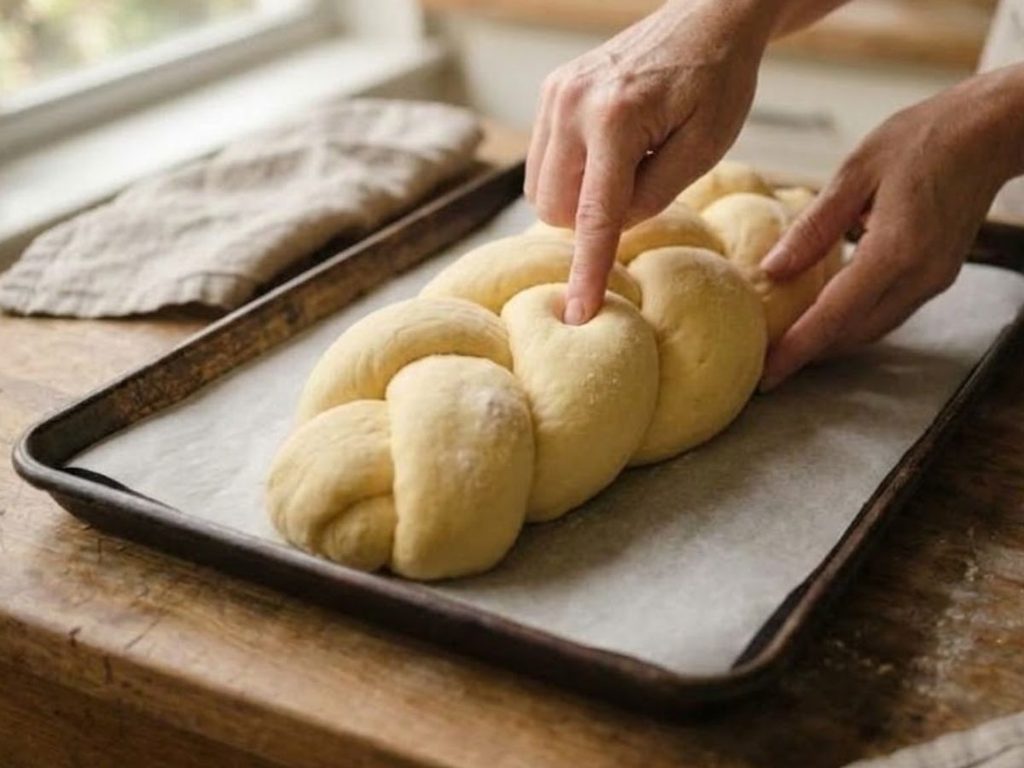
6Proof. Place the braid on a parchment-lined baking sheet, cover loosely, and let it proof for 2 to 3 hours at room temperature, until puffy and visibly larger, about one and a half times its size. Gently press a finger into the dough. It should spring back slowly, leaving a small dent.
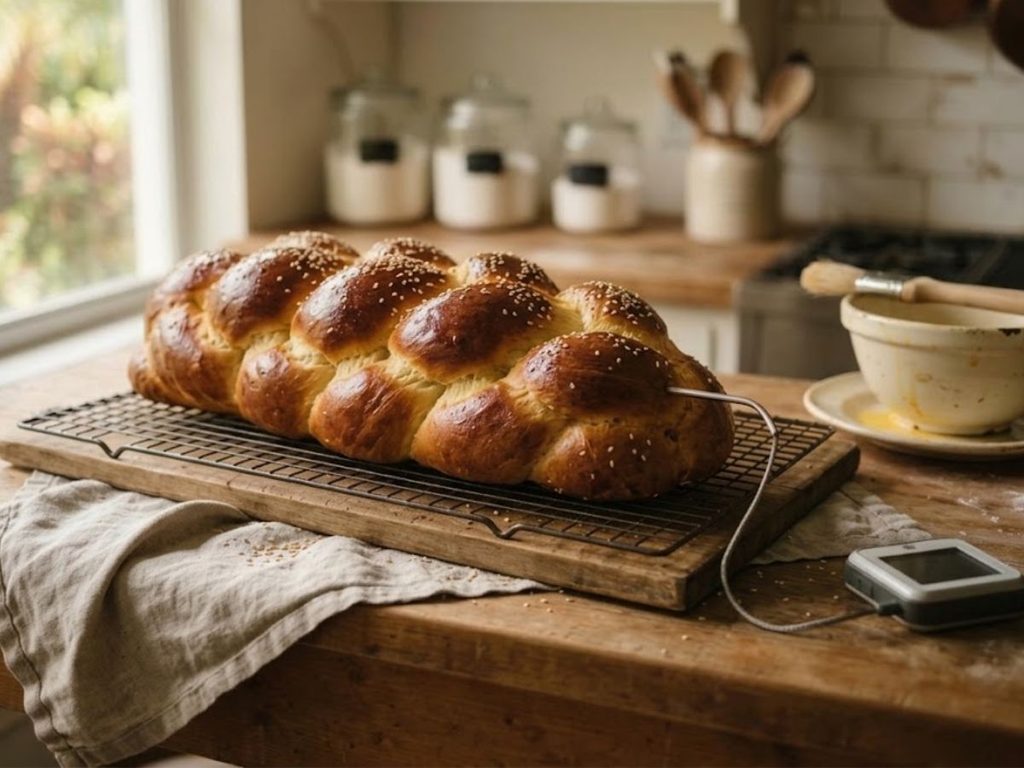
7Wash and bake. Preheat the oven to 350°F (175°C) with a rack in the middle while the loaf finishes proofing. Beat the egg with a splash of water. Brush the loaf with the egg wash, wait 10 minutes, and brush again for a deeper shine. Sprinkle with seeds, if using. Bake for 30 to 35 minutes, until deep golden brown and the center reads 190°F (88°C). If the top browns too fast, tent it loosely with foil. Cool on a rack for at least 1 hour, since slicing early leaves the crumb gummy.
Tips & Troubleshooting
- Dough is not rising: Enriched dough is slow. Move it somewhere warm, around 78°F (26°C), and make sure your starter was at its peak when you mixed.
- Braid lost its shape: The dough was overproofed, or the braid was too loose. Braid snugly, and bake when the loaf is puffy rather than doubled.
- Crust is too dark: Tent the loaf loosely with foil for the last 10 minutes of baking, since the egg wash and honey brown quickly.
- Challah is dense: It likely needed a longer rise. Go by the dough, not the clock, and give the braid its full proof.
- Ropes keep shrinking back: Rest them for 5 to 10 minutes and roll again. Do not use extra flour, since it makes them slip.
How to Store
To store: Keep the cooled loaf in a bag at room temperature for up to 3 days. It makes excellent French toast on day 3.
To freeze: Slice and freeze for up to 3 months, or freeze the whole loaf wrapped tightly. Thaw at room temperature.
Nutrition
Nutrition values are estimates per slice and will vary based on exact ingredients used.
250
CALORIES
39
CARBS (G)
7
PROTEIN (G)
7
FAT (G)
1.3
SAT. FAT (G)
1.1
FIBER (G)
5
SUGAR (G)
310
SODIUM (MG)
Desi’s Notes
For a six-strand braid, use the same dough and see our Six-Strand Braided Sourdough Loaf. For round challah, which is often made for the new year, coil one long rope into a spiral and tuck the end underneath.
Leftover challah makes outstanding Sourdough French Toast and Sourdough Bread Pudding.
For another enriched loaf, see Yuzu Matcha Swirl Babka.
Another enriched, shaped bread is Sourdough Pan de Muerto.
If your enriched dough will not rise, see Enriched Sourdough Problems.
Before You Bake
Scaling this recipe up or down? Run your numbers through the Sourdough Calculator. And if you want a printable reference for troubleshooting or timing, browse all six Printable Quicksheets.
New to sourdough? Start with the free course
Seven short lessons over 12 days, from mixing your first starter to baking your first loaf with it. Stop anytime.
One short lesson every couple of days. Seven in all, then you’re done. No spam. See our Privacy Policy.
Already have a starter? Bake your first loaf → · Already baking? Browse recipes →


Tried this recipe? Leave a star rating below. It takes 10 seconds and helps other bakers decide what to make next.
Baked this recipe your way? Share it in Community Bakes and inspire other readers.