Sourdough Scoring Patterns That Hold Their Shape
On This Page
- What scoring does for a loaf
- The two kinds of score
- Depth and angle at a glance
- Tools and dough prep
- How to score a loaf, step by step
- Six scoring patterns for boules and bâtards
- Design the score so the loaf has somewhere to go
- When a design blows open
- Questions bakers ask about scoring
- Your next bake
A score is a cut that tells the loaf where to open. Skip it and the dough still opens, just wherever it happens to be weakest, which is rarely where you wanted. That is how a loaf can bake beautifully and still split down its side.
The Short Answer
Make one deeper expansion cut so the loaf has a planned place to open, and keep every decorative cut shallow, about ⅛ to ¼ inch. Score cold dough with a sharp blade in one confident stroke each. Most designs that blow open trace back to a loaf with nowhere to expand, a proof that ran under or over, too little steam, or a dough too wet to hold the cut.
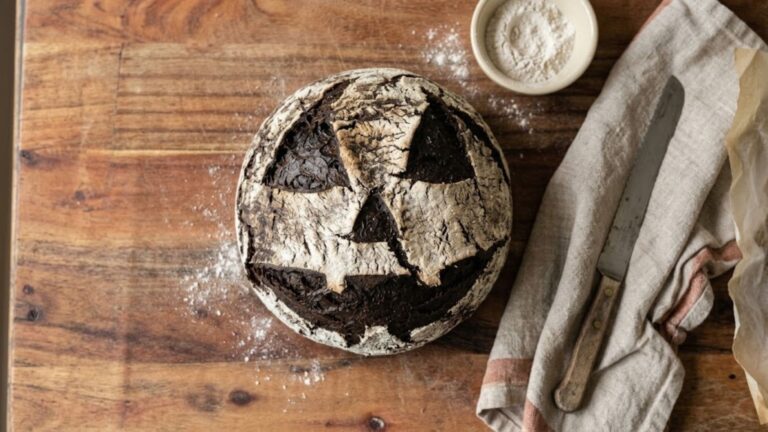
This guide covers the two kinds of score, how deep and at what angle to cut, six patterns for round and oval loaves, how to design so the loaf has somewhere to go, and what to do when a design blows open. I have baked the Black Cocoa Jack-o’-Lantern Boule and watched its scored face split wide, so I use that loaf as the worked example. For everything else I lean on published guides, mainly King Arthur Baking and a few home bakers’ guides, and I say so where their numbers differ.
What scoring does for a loaf
The crust sets from the outside in. While it is still stretchy, the gas inside the dough pushes the loaf upward, and that push is oven spring. Once the crust hardens, the window closes.
A score makes a thin spot in the skin that gives way first. According to King Arthur Baking, a loaf without that planned weak spot bursts at whatever weak spot shaping left behind. Steam in the oven helps by keeping the crust flexible for longer, which is why a covered Dutch oven works so well. The recipes on this site keep the lid on for the first 30 minutes of a full loaf for that reason.
The two kinds of score
An expansion score is the working cut. It is deeper, usually one or two long strokes, and it decides where and how far the loaf opens. A decorative score is the pattern. It is shallow and sits on the surface, so it shows as a pale line after baking without opening much.
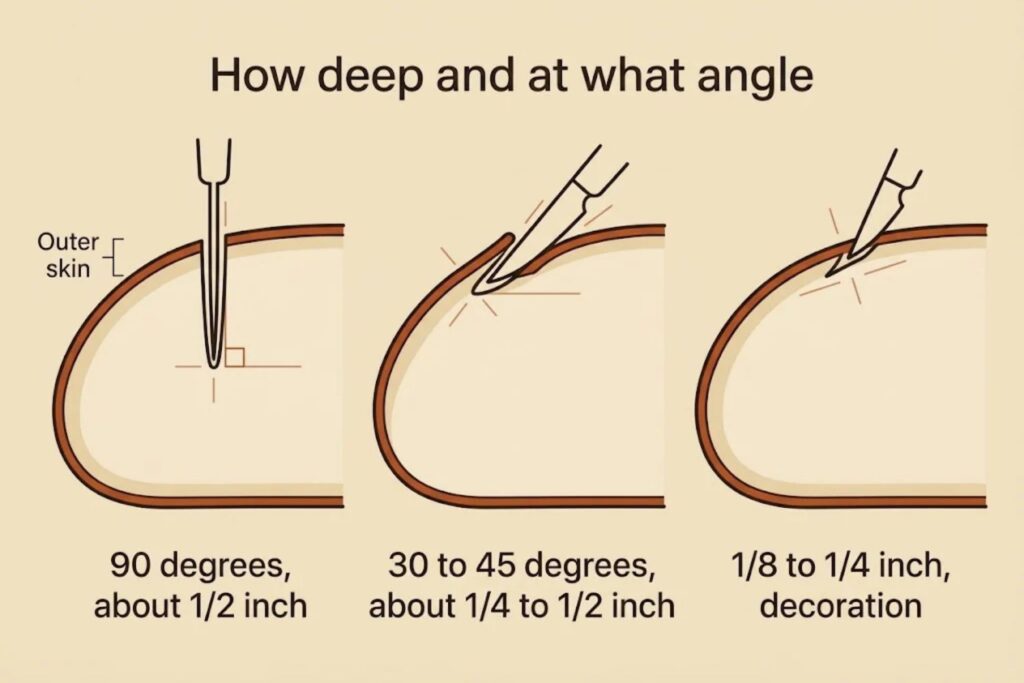
Guides I read put an expansion cut at about ½ inch deep and a decorative cut at about ⅛ to ¼ inch. King Arthur gives ¼ to ½ inch for an angled ear cut, enough to get past the dry outer skin so the cut does not seal itself shut. Treat every number here as a starting point and adjust to your dough.
Plenty of designs pair one deep cut with shallow decoration around it. Some bakers also cut the decoration first and make the deep cut five to seven minutes into the bake. Nourish and Nestle calls it the 7-minute method. I have not tried it, so I am passing it along as published.
Depth and angle at a glance
I measure the angle between the blade and the surface of the loaf. Straight down is 90 degrees, and a lower number lays the blade flatter against the dough.
| Cut | Depth | Blade angle | What happens |
|---|---|---|---|
| Straight expansion cut | About ½ inch | 90 degrees | Splays open like a book, with no ear |
| Angled cut for an ear | About ¼ to ½ inch | About 30 to 45 degrees | The skin peels back as a flap that lifts |
| Decorative cut | About ⅛ to ¼ inch | 45 to 90 degrees | Shows as a pale line, opens little |
The angle numbers vary between sources. One guide says cuts shallower than 45 degrees can collapse, while King Arthur suggests about 30 degrees with a curved blade and about 15 degrees with scissors. I would start near 45 degrees and go lower only once your hand is steady.
Tools and dough prep
A lame holds a blade at a controlled angle. A single-edge razor blade or a very sharp, thin knife also works. My scoring tools guide compares the shapes and handles in more detail. Blades dull faster than most people expect, and one guide suggests changing the edge every 10 to 30 loaves. A dull blade drags and tears the dough.
Cold dough scores cleaner. Straight from the fridge the skin is firm and the blade glides. Dough softens faster in a warm South Florida kitchen, so I would score one loaf at a time and keep the next one chilled. A light dusting of flour, or rice flour, gives the cut something pale to show against, which matters on a dark loaf like black cocoa.
Cut each line in a single stroke. Going back over a line drags the dough and leaves ragged edges.
Very wet dough holds a score poorly. King Arthur says an over-hydrated dough lacks the structure to open a score and suggests lowering the hydration. With a wet dough I would choose a simpler design and let one expansion cut do the work.
How to score a loaf, step by step
- Chill the shaped, proofed loaf. After a cold proof, score it straight from the fridge. If you proofed on the counter, one guide suggests about 30 minutes in the freezer first.
- Turn the loaf out onto parchment and dust the top lightly with flour or rice flour so the cuts show.
- Sketch the design with a toothpick or skewer if it is anything more involved than a cross. A faint line is easy to follow, and a wrong line is easy to brush away.
- Decide where the loaf will open before you cut any decoration, and mark that expansion cut first.
- Make each cut in one confident stroke at the angle and depth you chose. Do not go back over a line.
- Load the loaf into the hot Dutch oven right away and put the lid on at once to trap steam.
Six scoring patterns for boules and bâtards
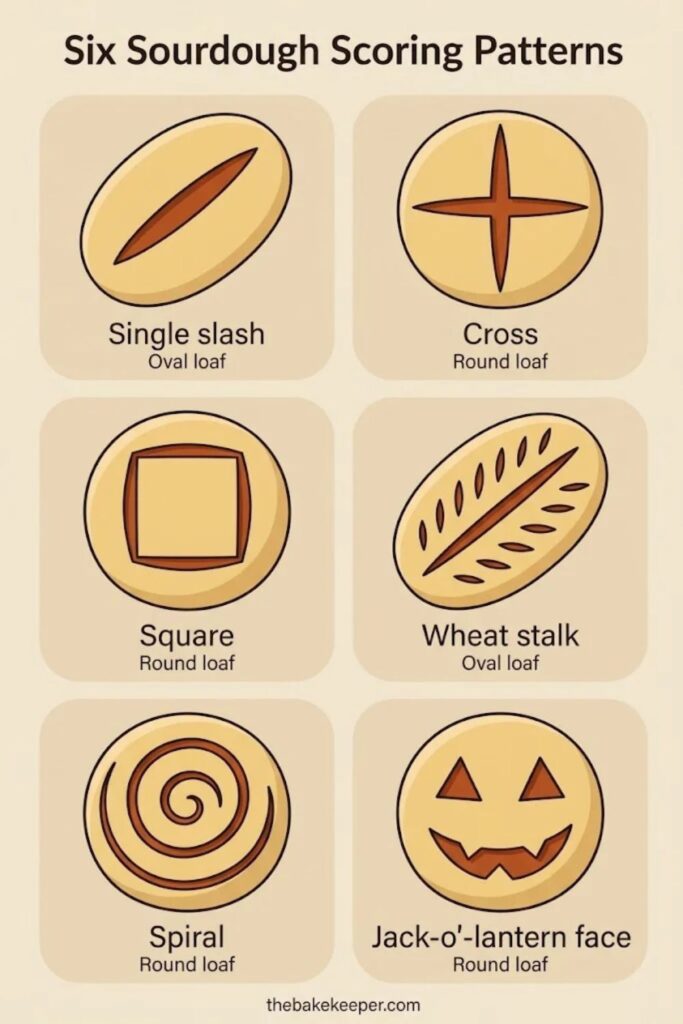
Round loaves (boules) and oval loaves (bâtards) open differently, so pick the pattern for the shape you have. King Arthur notes that many small, shallow cuts spread the pressure so the loaf opens across the whole surface, while fewer, deeper cuts let it open dramatically in a few spots.
| Pattern | Best on | Cut type | Skill level | Where the loaf expands |
|---|---|---|---|---|
| Single slash | Bâtard | Expansion | Easy | Along the slash |
| Cross | Boule | Expansion | Easy | From the center |
| Square | Boule | Expansion | Moderate | The top lifts inside the square |
| Wheat stalk | Bâtard or boule | Expansion plus decoration | Moderate | Along the center cut |
| Spiral | Boule | Decorative | Moderate | Needs an added expansion cut |
| Jack-o’-lantern face | Boule | Decorative | Harder | Needs an added expansion cut |
How to score a single slash
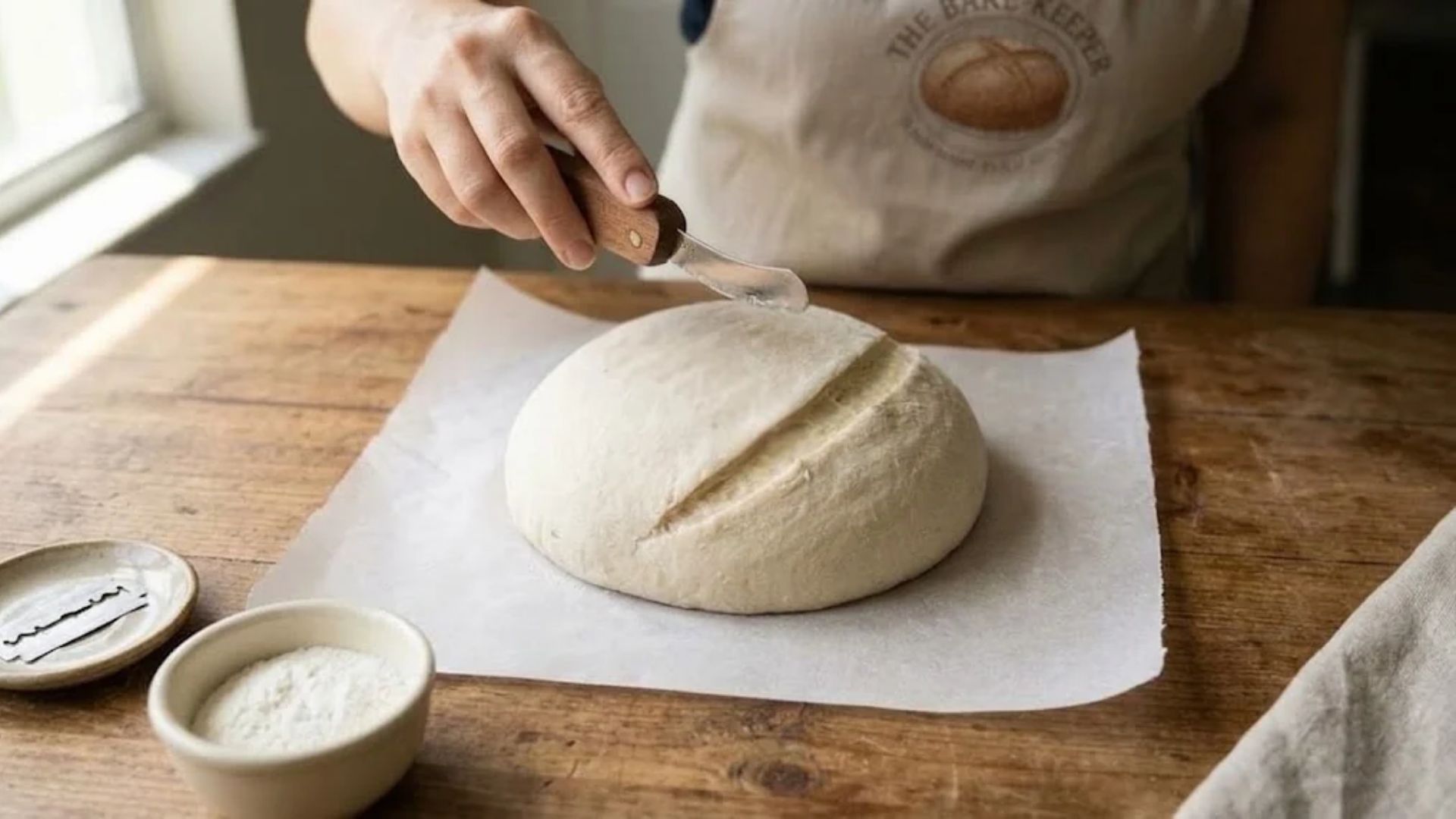
One long cut along the loaf, with the blade held at roughly 45 degrees so the skin peels back into an ear. Start an inch or so in from one end and cut in one stroke, stopping an inch short of the other end. It is the easiest pattern to get right, and it is a good first cut for a bâtard.
How to score a cross on a boule
Two cuts that cross at the center. King Arthur describes making one cut deeper and the crossing cuts shallower, so the center splays open most and the arms open less. That makes the cross forgiving, because the center gives the dough an obvious place to push through.
How to score a square on a boule
A square cut about an inch in from the edge, with the blade angled slightly outward. The center tends to lift as one piece. Use a ruler or a small cutter to mark the square lightly first, because a crooked square shows.
How to score a wheat stalk
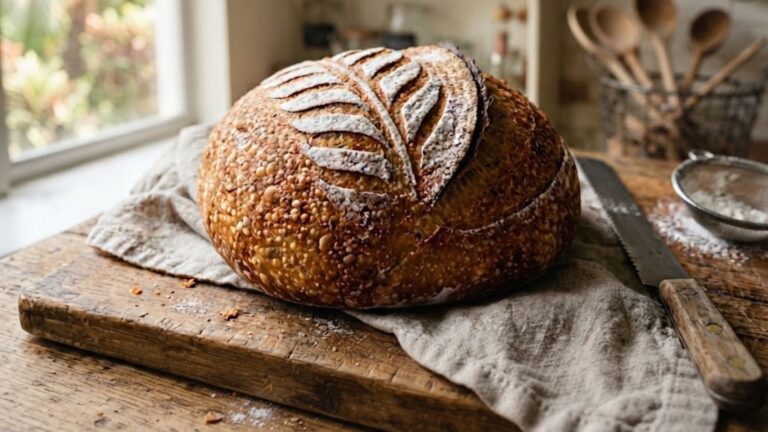
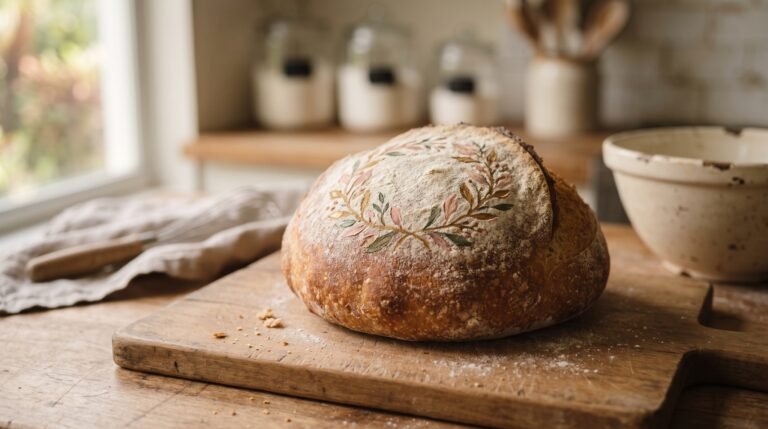
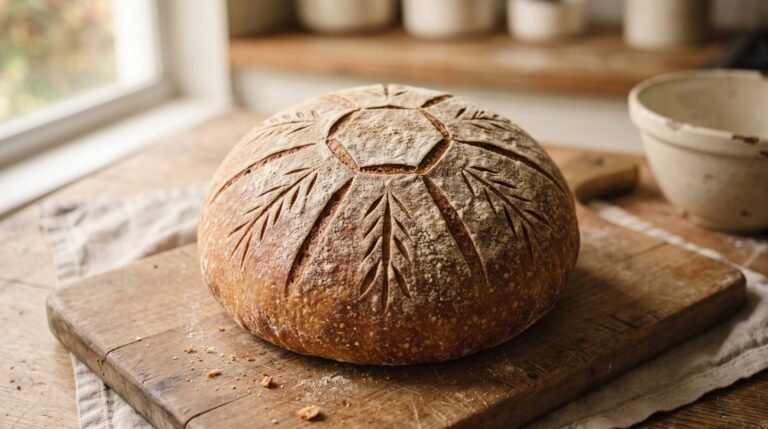
A single central slash for the stalk, then short, shallow, angled cuts on either side for the grains. The center cut is the expansion score. The side cuts are decorative, so keep them to ⅛ to ¼ inch. The full method is in the Wheat Stalk Scored Sourdough Boule recipe.
How to score a spiral
A spiral works best when you can turn the loaf as you cut, and a lazy Susan makes that easy. Every line is decorative, which means the crust stays sealed around the pattern. I suspect a spiral with no added expansion cut tends to burst somewhere unplanned, so I would add one shallow relief cut around the side.
How to score a jack-o’-lantern face
Two triangle eyes and a jagged smile, plus a nose if you like, all cut at decorative depth. The full method is in the Black Cocoa Sourdough Jack-o’-Lantern Boule recipe. Because every cut is shallow, the face needs a planned exit for the loaf, which brings us to design.
Design the score so the loaf has somewhere to go
Every design needs an exit. One expansion cut or a shallow relief score around the side gives oven spring a route that is not through your face or your spiral. A face is only a handful of cuts, and since fewer, deeper cuts open dramatically in a few spots, I suspect a face concentrates the pressure in exactly the place you drew it.
Keep decorative cuts shallow and short. King Arthur warns that cutting too deep leaves an opening too large to support the dough around it, so the loaf shows caved-in sections.
Match the design to the dough. A strong, well-proofed loaf at moderate hydration holds detail. A wet or underproofed dough does not, and an overproofed one gives little spring at all. If the dough is weak, choose the cross or the single slash.
Practice on a small loaf before you commit a design to a showpiece bake. The Snowflake Scored Sourdough Boule is a natural next design once the cross feels easy. Change one thing per bake so you can tell which change worked.
When a design blows open
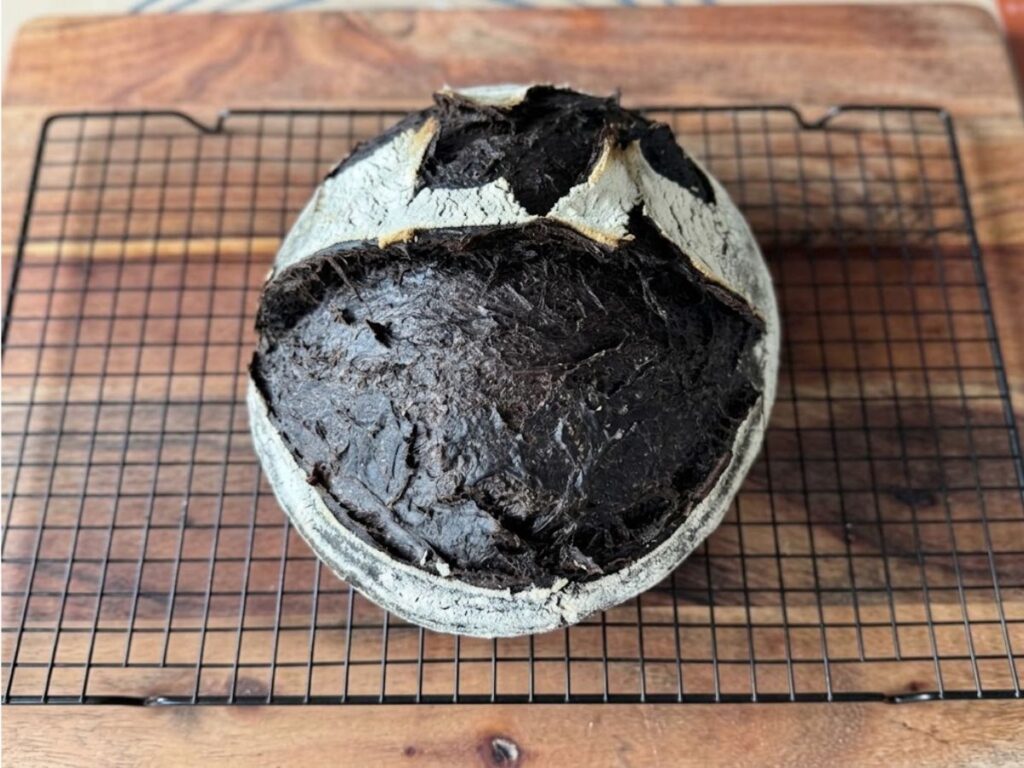
This is my black cocoa jack-o’-lantern boule. It baked nicely, but the scored face did not hold its shape and opened wide in the oven. I cannot say for certain which factor caused it, so here is how I would work through the likely ones.
| What you see | Likely cause | What to change |
|---|---|---|
| The face splits wide and the crust bursts past your cuts | The loaf had no planned place to expand | Add an expansion score around the side, away from the design |
| Cuts gape and the loaf tears at the base | Underproofed dough, or a score that was too shallow | Extend the proof, and keep the deep cut on top |
| Cuts stay closed and the pattern looks flat | Overproofed or very wet dough, or too little steam | Shorten the proof, lower the hydration, keep the lid on |
| Ragged edges along the cuts | A dull blade, or warm or overproofed dough | Use a fresh blade, and score cold dough that was proofed a little less |
Each fix comes from the same idea. The loaf will open somewhere. Your job is to pick the place. If the trouble is a loaf that will not rise or spreads flat, the proofing and scoring problems page sorts those out.
For the angled flap, hold the blade low and slice just under the skin so it peels back and stays attached at the ends of the cut. A straight-down cut splays open like a book instead. If the cut seals shut, go a little deeper next time.

Questions bakers ask about scoring
How deep should you score sourdough?
About ½ inch for an expansion cut and about ⅛ to ¼ inch for a decorative one. If the cut closes up, go deeper. If the loaf tears at the base or the design gapes, go shallower and check your proof.
What angle should the blade be?
Around 45 degrees for an ear, and 90 degrees if you want a straight cut that splays open. Lower angles peel back a larger flap but can collapse if the cut is too deep.
Why did my score blow open?
Usually because the loaf had no planned place to expand, so it pushed through the weakest part of your design. An expansion cut away from the pattern helps. An underproofed loaf makes it worse, and so does too little steam.
Why did my score not open at all?
Check four things in this order. First, whether the dough overproofed. Second, whether the dough is very wet. Third, whether the cut was deep enough to pass the skin. Fourth, whether the lid went on right away to trap steam.
How cold should the dough be when I score it?
Firm and cold. King Arthur notes that warm dough is harder to score than cold, firm dough, so a loaf straight from the fridge cuts cleanest. In a hot kitchen the surface softens within minutes, which is why I would score one loaf at a time.
When should I score, before the bake or during it?
Almost everyone scores before the loaf goes into the oven. The 7-minute method described earlier is the main exception, and it splits the work into shallow decoration first and a deep expansion cut a few minutes into the bake. Start with scoring before the bake until your cuts are consistent.
Can I score without a lame?
Yes. A single-edge razor blade or a very sharp, thin knife works, as long as it slices without dragging the dough. King Arthur also describes snipping with scissors at a low angle to make flaps. A knife with a serrated edge tears the dough, so skip it.
Your next bake
Bake one small boule, such as the plain sourdough loaf, with a single plain cross, cut in two strokes from cold dough, with one cut about ½ inch deep and the other shallower. Photograph it. On the next bake add one decorative cut and photograph that loaf too, so you can compare the two side by side. If a loaf surprises you, the Reading Your Bread guide matches crumb and crust to likely causes. When you would rather skip cutting a design altogether, the Flour Stencil Sourdough Boule and the Painted Sourdough Boule decorate the loaf without relying on a score.
Knead to Know?
New recipes and sourdough troubleshooting, delivered before your starter even finishes its next rise.
Get the latest insights with no spam, just new recipes and baking tips. Unsubscribe anytime. See our Privacy Policy.